
How to Coordinate People Who Use Different Messaging Apps
Ten people, five messaging apps, one lunch. The advice you usually get is to pick an app and make everyone use it, which costs you a favour, fails without telling you, and breaks on the first holdout. There is a smaller move that works on every platform at once.

Quick answer
Do not try to consolidate your group onto one app. That request spends the organiser's social capital, fails silently when people say yes and never install, and collapses the moment one person stays behind.
Do not relay the plan by hand either. Copying the same facts into five threads means five versions that drift apart, and the threads cannot correct each other because they cannot see each other.
Instead, put the plan in one record with one address and send that link into every thread. A URL is the only object that behaves identically in WhatsApp, iMessage, Signal, Messenger and plain SMS, and it costs the guest nothing to open.
Count the apps in your group before you plan anything
Four people are on WhatsApp. Three are on iMessage and will not be moved.
One only answers on Signal. One insists on Messenger because that is where he has been since 2011. And there is an aunt who does SMS, full stop, and who will be genuinely hurt if she is left out.
That is ten people and five apps, for a lunch. Nobody in that group did anything unreasonable.
The usual advice at this point is to pick one app and get everyone on it. That advice is worse than useless, and the rest of this article is about what to do instead.
Why "everyone just download X" quietly fails
It sounds like the obvious fix. One app, one thread, problem solved.
It fails for three reasons, and they compound.
It spends the organiser's social capital
Asking somebody to install an app is asking for a favour. Small, but real, and it comes out of the same budget as "can you drive" and "can you front the deposit".
Most organisers only get to make a few of those asks before people start finding the plan tiring. Spending one of them on plumbing rather than on the event itself is a bad trade.
It also puts the organiser in a role nobody enjoys. You become the person who wants things a particular way, which is a strange thing to be about a lunch.
It fails silently
People say yes to installs and then do not install. There is no bounce message, no failure notice, nothing.
The organiser assumes the group is now unified. The evidence for that assumption is the absence of complaints, which is the weakest evidence there is.
Three weeks later somebody says "wait, what group?" and it turns out they downloaded the app, never opened it, and never got the invite. This is the standard outcome, not the unlucky one.
An install request that nobody refuses is not the same as an install request that worked.
One holdout undoes all of it
This is the part that makes the whole strategy fragile. Nine out of ten is not ninety percent solved.
The moment one person is outside the new group, someone has to relay to them by hand. The old channel reopens, the plan is now in two places, and you have all the cost of the migration with none of the benefit.
And every real group has a holdout. Sometimes it is a phone that will not run the app, sometimes a workplace policy, sometimes just a person who does not want another icon.
The relay problem, which is the actual problem
So the organiser does the sensible thing and relays. Venue change goes into the WhatsApp group, then gets retyped into the iMessage thread, then sent to Signal, then Messenger, then as a text to the aunt.
This works exactly once. It is what people mean when they say co-ordinating a mixed group is exhausting.
What breaks is not effort. It is copying.
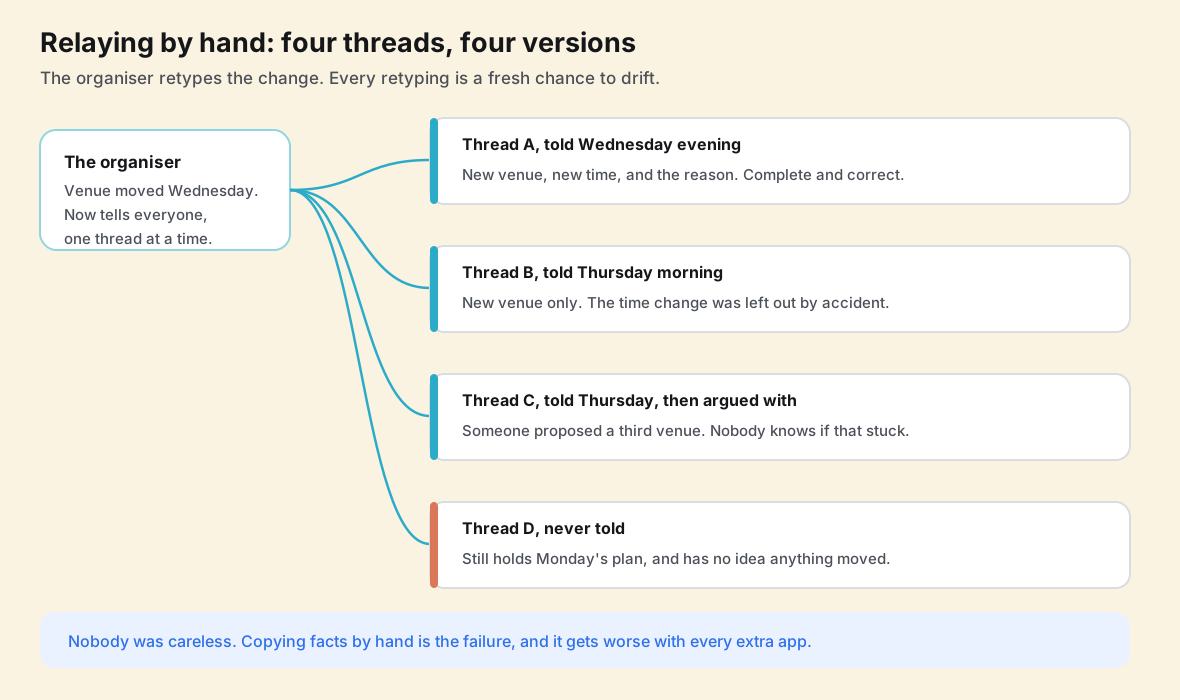
Every relay is a fresh chance to leave something out. You mention the new venue and forget the new time, because in your head the time was settled days ago.
Every relay also happens at a different moment. Thread A hears on Wednesday night, thread C hears on Thursday lunchtime, and in between somebody in thread C proposed something else.
Then the threads start having separate conversations about the same plan. That is the moment the plan properly forks, and it is a well documented way for event information spread across multiple apps to end up contradicting itself.
Now the organiser is not relaying facts. They are reconciling threads, which is a job, and one that nobody agreed to do.
Why the group cannot self-correct
In a single thread, wrong information gets corrected. Somebody says the wrong time and four people jump on it within a minute.
Split the group across five apps and that immune system stops working. The people who could correct you are not in the room where you were wrong.
So errors survive. The person holding Monday's plan holds it confidently, for a fortnight, because nothing they can see disagrees with them.
Judge platforms on what they do to outsiders
Here is the shift that makes mixed-app planning tractable. Stop asking which app is best and start asking how each one behaves toward someone who is not on it.
That is a real, testable property, and it is different from every feature comparison you have read. It is also the only property that matters when your list has five apps on it.
Three questions do most of the work.
- Does a link open without an install?
- If the thing you share resolves in any browser, everyone on your list can read it, whatever they use. If it deep-links into an app and dead-ends without it, half your group sees a wall.
- Does a guest need an account to answer?
- Reading is easy. Answering is where drop-off happens, because an account wall converts a willing guest into a message you now have to chase.
- What happens to the person outside the platform?
- Some platforms degrade gracefully and let outsiders read or reply in a reduced way. Others treat non-members as invisible, which puts the organiser back on relay duty.
Notice that none of those questions are about the quality of the app. They are about the shape of the boundary around it.
| Property | What "good" looks like for a mixed group | Why it decides the plan |
|---|---|---|
| Shareable link | Opens in a browser with no app installed | The single test that determines whether your outsiders are reachable at all |
| Guest identity | A name is enough, no account required | Accounts are where willing people quietly stop |
| Directory model | Reachable without you holding a phone number | Phone-number platforms exclude anyone you only know socially |
| Group membership | You can be told things without joining anything | Joining exposes you to a group, which is a bigger ask than it looks |
| Update behaviour | Editing a fact replaces the old one | Append-only threads leave both versions equally visible |
| Answer format | A named yes, no or maybe per person | Reactions and replies are social signals, not a headcount |
| Outsider handling | Non-members can still read the current plan | Determines whether the organiser has to relay by hand |
Run your own group through that table honestly and something becomes clear. Most of the boxes have nothing to do with which app anybody prefers.
The apps are all fine at conversation. That is what they were built for, and they are genuinely good at it.
What none of them can do is be visible to somebody who is not inside them. That is not a defect, it is the definition of a private messaging platform.
The identity trap nobody mentions
There is a second boundary hiding underneath the app boundary, and it catches people out.
Some platforms identify you by phone number. Others identify you by an account name, or by an email address, or by a handle that is only meaningful inside one community.
Those are not interchangeable. You may know somebody well enough to invite them to dinner and not well enough to have their number.
The phone number case is the sharpest, because a number is a real identifier with its own standard: RFC 3966 defines the tel URI scheme for exactly that reason. Handy for dialling, and a genuinely awkward thing to require before somebody can be told where lunch is.
It cuts the other way too. Adding someone to a group chat hands their number to everyone else in it, which is why inviting people without exposing phone numbers is a live concern for anyone organising across mixed circles.
So the question "which app should we use" has a hidden second half. Which identifier is everybody willing to hand over, and to whom.
The record has been standardised since 2009
Here is the reassuring part. The thing you are trying to send across five apps already has a formal definition.
It is the event object, specified in RFC 5545, the IETF's iCalendar specification. It is the reason a .ics file opens on essentially every device you own.
The fields read like a list of everything a relayed message loses.
| Field | What it holds | What hand-relaying does to it |
|---|---|---|
UID | One permanent identity for this event | Creates a separate unnamed copy in every thread |
DTSTART / DTEND | One start and end, with a time zone | Carries whichever time the organiser remembered that evening |
LOCATION | One current place | Updates in the threads that got the message, not the others |
ORGANIZER | Whose version is authoritative | Makes each thread's most recent message locally authoritative |
ATTENDEE with PARTSTAT | Each person and their actual answer | Scatters the headcount across five different reply formats |
SEQUENCE | Which revision this is | Offers no way to tell an old copy from a current one |
STATUS | Confirmed, tentative or cancelled | Reduces cancellation to whoever happened to see the message |
LAST-MODIFIED | When this last changed | Hides staleness completely, in every thread at once |
The one worth staring at is PARTSTAT, the per-person answer. Its default value is NEEDS-ACTION, which means the standard gives silence a name.
Across five apps, silence has no name at all. A thumbs-up in one thread, a "sounds good" in another and nothing from the Signal holdout are three completely different things that you are currently treating as one.
There is a companion specification too, RFC 5546, which defines how invitations and replies travel. It names the invitation a REQUEST and the answer a REPLY.
So none of this needs inventing. The record, the invitation and the response were all specified before most of the apps in your group existed.
What actually works: point, do not copy
The move is small and it feels almost too obvious. Stop sending the plan and start sending an address where the plan lives.
Every thread keeps its own conversation. Each one holds a pointer rather than a copy, and the pointer never goes stale because it does not contain anything.
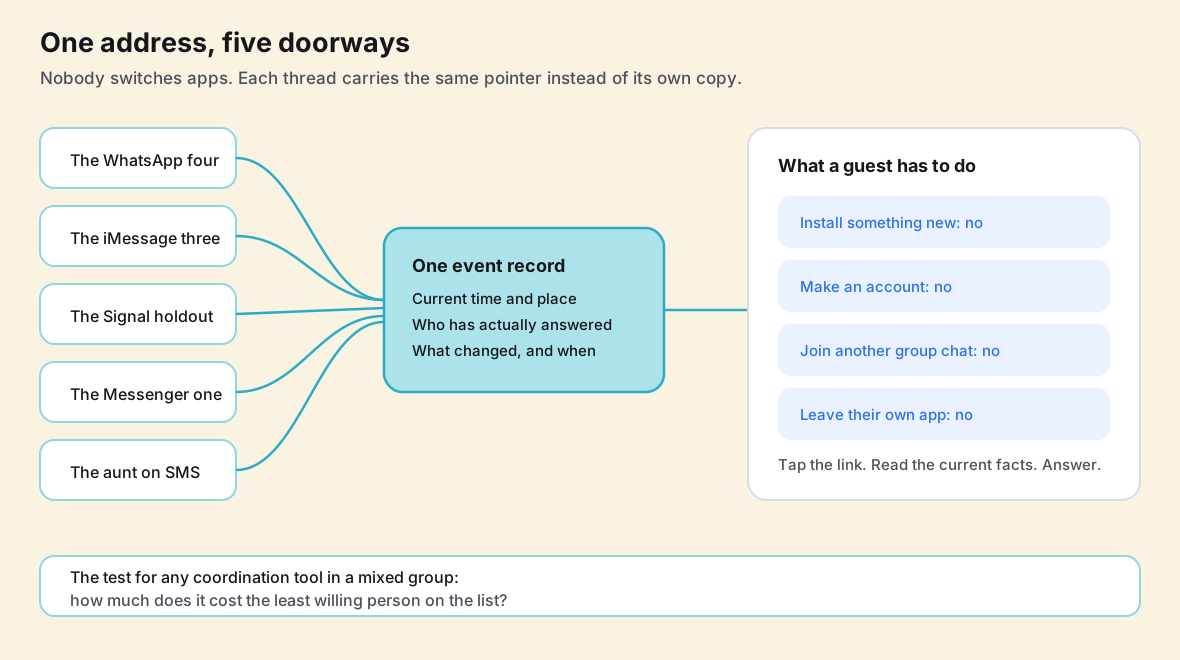
This works because a URL is the one thing every platform agreed on. WhatsApp, iMessage, Signal, Messenger, Telegram, Discord and plain SMS all render a link and all open it in a browser.
They agree on nothing else. Not reactions, not polls, not read receipts, not formatting, not group size.
A link is also the lowest-cost object you can send someone. It asks for a tap, and the person deciding whether to comply is the least willing person on your list.
What changes for the organiser
Every question about the plan now has the same answer, and the answer is the link. You stop composing and start pasting.
You also stop being the reconciler. When the venue changes you edit one record, and the five threads are correct the moment you save, because none of them were carrying facts to begin with.
This is the practical version of building one source of truth for a group event. It works across apps for the same reason it works within one.
What changes for the guests
Very little, which is the point. They stay in the app they like, talking to the people they normally talk to.
They get one extra thing: somewhere to look. When they are three minutes late and cannot remember the address, they tap the last link instead of scrolling.
Nobody has to be told about the system, either. Sending a link instead of forwarding a message requires no explanation and no buy-in from anyone.
How to run a mixed-app plan without relaying
Here is the procedure, in the order that actually holds up. It takes about ten minutes the first time and about ninety seconds after that.
- List the humans, not the apps. Write down the ten people who need to be there. Do this before you think about channels, because starting from apps quietly loses whoever is hardest to reach.
- Find your hardest case. Identify the one person with the fewest options: the aunt on SMS, the friend with the work phone, the one who has muted everything. Whatever you choose has to work for them, because they are the constraint.
- Put the facts in one place. Write the date, the time, the address, the cost and what to bring into a single record that lives at one address. Not a message, not a pin, something you can edit later.
- Check it opens cold. Send the link to yourself and open it on a phone that is signed out of everything. If it demands an install or an account before showing anything, it will fail on your hardest case, and you should fix that now.
- Drop the pointer into every thread. Post the same link in all five conversations, with one line of context each. Say nothing about the plan itself, because anything you type is a copy that can drift.
- Answer every question with the link. When somebody asks what time, resend the pointer rather than typing the time. It feels blunt for roughly one day and then it feels like a weight lifting.
- Change the record, never the threads. When something moves, edit the record once and let the threads stay as they are. If you also announce it in five places, you have rebuilt the relay problem on top of the fix.
- Chase the silent by name. Look at who has not answered on the record, and message those people individually, in whatever app they use. Three named nudges beat one more "can everyone confirm" in a group of ten.
Step four is the one people skip, and it is the one that saves the day. Testing a link while logged in tells you nothing about what your aunt sees.
When you genuinely should consolidate
None of this means one shared app is always wrong. Sometimes it is clearly right, and pretending otherwise would be silly.
Consolidate when the group is ongoing rather than one-off, when the conversation itself has value beyond this event, and when nobody has to install anything they do not already have.
A weekly five-a-side team should have one group. A choir, a book club, a running crew: those are communities, and communities deserve a home.
A lunch is not a community. It is an event with a start and an end, and building a permanent group chat for it is why adding somebody to a group chat feels awkward in the first place.
| Signal in your group | Consolidating helps | Pointing at a record helps |
|---|---|---|
| The group meets repeatedly | Yes, the thread earns its keep | Also fine, but less necessary |
| This is one event and then nothing | No, you are building a ghost town | Yes, nothing to clean up afterwards |
| Somebody cannot install the app | No, it breaks on your hardest case | Yes, a link needs no install |
| Guests do not all know each other | No, it forces introductions and exposes numbers | Yes, guests never see each other's details |
| The plan is likely to move | Partly, one thread beats five | Yes, one edit updates everyone |
| You need a real headcount | No, threads cannot count | Yes, that is the record's job |
| The fun is in the chatter | Yes, absolutely, leave it alone | Neutral, the record does not touch chat |
Most groups need both, and that surprises people. Conversation in the apps everyone already loves, facts in one place everyone can reach.
The etiquette of not making it weird
There is a social layer to this, and ignoring it is how good systems die.
Do not announce the system. Nobody wants to hear that you have adopted a new approach to group co-ordination, and saying so makes a lunch feel like a project.
Just send the link with a normal sentence. "Sunday lunch, details here, let me know if you're in" is the entire rollout.
Do not scold people for asking questions you have already answered. Send the pointer again, cheerfully, forever. The whole point is that resending costs you nothing.
And keep talking in the threads. If the group chat goes quiet because you moved everything to a record, you have taken something away, which is the opposite of what this is for. The apps keep the jokes, and the record keeps the address.
The three sentences that do most of the work
Some phrasings hold up better than others across five apps. These three are worth stealing.
"Everything lives here, I'll keep it updated." Sets the expectation once, promises maintenance, and asks for nothing.
"Same link as before, the time moved." Tells people what changed without retyping the plan, so there is nothing new to misread.
"Can you tap yes or no on the link, it's the only way I can count." Honest about why, and it converts a vague thumbs-up into an actual answer.
What to do when it is already a mess
Sometimes you inherit the situation. Five threads, contradictory information, and the thing is on Saturday.
Read all five threads once, end to end, and write down what is currently true. Do this privately, and do it properly, because you are about to become the only correct source.
Then put those facts in one place and send that link into every thread with the same sentence. Do not explain the history and do not apologise for the confusion.
Expect one round of "wait, I thought it was the other place". Answer each one with the link, not with an explanation, because an explanation is another copy.
By the second day the threads stop arguing about facts. They go back to arguing about whether the new place is any good, which is what they were for.
If your specific mess is a split between WhatsApp and iMessage, or a plan scattered across WhatsApp, Telegram and Discord, the recovery is identical. The number of apps changes the tedium, not the method.
Where Ontaym fits
Ontaym is built to be that one address, which is the honest reason this article exists.
You make an event, you get a link, and you drop it into whatever threads your group actually uses. Guests open it in a browser and answer without an account, an install or a new group chat.
When the venue moves you edit the record once. Everyone who taps the link sees the change, whichever app they came from.
It is a deliberately narrow scope, and it will not fix everything. If your group needs a home rather than a plan, a shared community space is the better answer, and if it is coffee with one friend you need nothing at all.
The short version
Mixed-app groups are the normal case now, not an edge case. Ten people and five apps is what a real invitation list looks like.
Trying to fix that by consolidating apps costs you social capital, fails without telling you, and collapses on one holdout. Trying to fix it by relaying costs you an evening a week and produces threads that quietly disagree.
The fix is to stop sending facts and start sending an address. Compare tools on whether a link opens cold, whether a guest can answer without an account, and what happens to the person outside.
Then leave the conversations exactly where they are. Everyone keeps their app, the aunt keeps her SMS, and there is finally one place where the address is right.
Frequently asked questions
How do I invite people who all use different messaging apps?
Put the plan in one record that has a single web address, then paste that link into each thread your guests already use. A link renders and opens in every mainstream messaging app, so nobody has to install anything or move. Add one line of context per thread and resist retyping the details themselves.
Why is asking everyone to download the same app a bad idea?
It costs you a favour from every person you ask, and organisers only get a few of those before a plan starts feeling like work. It also fails silently, because people agree to install and then do not, and you find out weeks later. Worst of all, a single holdout puts you straight back on manual relay duty.
What goes wrong when I just copy the details into each thread?
Each copy is written at a different moment and leaves out something different, usually the change you consider already settled. The threads then have separate conversations about the same plan and end up disagreeing. Because the threads cannot see each other, nobody is present to correct the version that is wrong.
Which messaging app is actually best for planning across a mixed group?
None of them, and that is not a criticism. Every private messaging platform is invisible to people outside it, which is what makes it private, so no single app can reach a list that spans five of them. Compare them on whether a shared link opens without an install, whether answering needs an account, and how the platform treats a non-member.
How do I get a real headcount when replies arrive in five places?
Stop collecting answers in the threads and collect them on the record instead. Reactions, replies and quoted messages are social signals in five incompatible formats, so counting them by hand is guesswork. Then chase the people the record shows as unanswered, by name, in whatever app they use.
Do I need everyone's phone number to do this?
No, and that is one reason the link approach travels well. Phone-number platforms assume you hold a number for every guest, which excludes people you only know socially, and adding someone to a group chat hands their number to everyone else in it. A link can be forwarded by anyone without exposing any contact details.
Is there ever a good reason to move everyone onto one app?
Yes, when the group is ongoing rather than a one-off and the conversation has value beyond this event. A weekly football team or a book club genuinely benefits from a shared home. A single lunch does not, and building a permanent group chat for it leaves everyone with a thread they will mute by Tuesday.
What if the plan is already scattered and the event is this weekend?
Read every thread once, write down what is actually true right now, and put those facts at one address. Send that link into all the threads with the same short sentence, without explaining the history. Answer the follow-up confusion by resending the link rather than restating the details.
Give your next plan one address instead of one more thread.
Plan it with Ontaym