
Why Discord Is Excellent for Communities but Complicated for Offline Plans
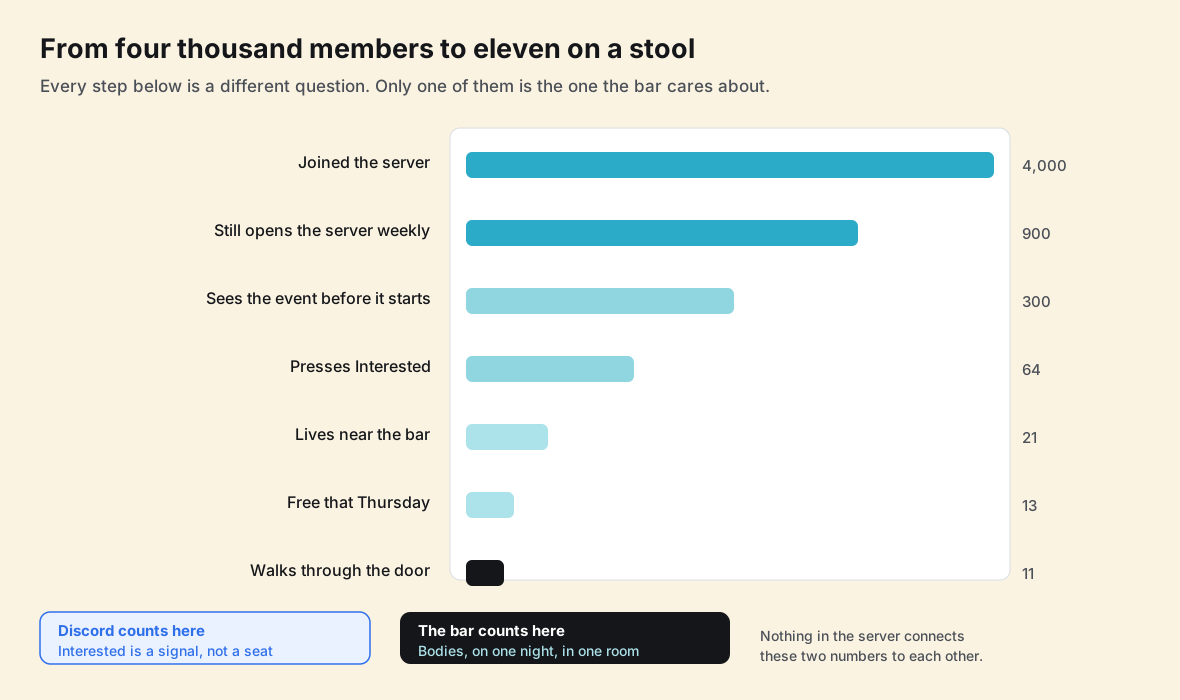
Discord gave communities real structure: servers, roles, permissions, threads, and a native Scheduled Events feature with a date attached. It is still unreasonably hard to get eleven of four thousand members into the same bar on a Thursday, and the reason has almost nothing to do with missing features.

Quick answer
Discord is unusually well built for communities and it does have a real event object. Scheduled Events carry a start time, a location and an organiser, which is more than most chat apps manage.
What it does not carry is a guest list. The Interested button is an honest low-cost signal about an online event, and organisers keep reading it as an RSVP for a physical room.
Underneath that sit three harder facts: server membership is not a social relationship, members are scattered across time zones, and asking a Discord friend for a real name and a city undoes the thing they liked about being there. The fix is to keep the announcement in the server and put the attendance record somewhere private beside it.
Four thousand members, eleven stools
A server you love has four thousand members. Twelve channels, a role colour scheme somebody spent a weekend on, and a voice channel that never empties before 2am.
Somebody suggests a drink. Same city, a Thursday, a bar that takes bookings for twelve.
Getting eleven people to that bar will be harder than anything the server has done all year. Harder than the tournament. Considerably harder than the charity stream.
This is the part that confuses people, because Discord is not a badly built product. It is one of the best organised social tools ever shipped to consumers.
Servers have channels. Channels have permissions. There are roles, categories, threads, pinned messages, and a native Scheduled Events feature with a real date attached.
None of that is the problem. That is exactly why this is worth writing about.
Give Discord the credit it has earned
Start by being fair, because most articles about this skip straight to the complaint.
Discord did the thing almost no chat app does. It built an actual event object into the product, and it is not a gimmick.
Read Discord's own documentation for the guild scheduled event object and the shape is immediately recognisable. It has a name, a description, a scheduled start time, a scheduled end time, a creator, and a cover image.
It has three entity types, which is Discord's word for where the thing happens. Stage instance, voice, and external, where external is the one that covers a bar with an address.
It has a status field with four values: scheduled, active, completed and cancelled. It even has a recurrence rule, and the documentation is explicit that the recurrence model is based on the iCalendar standard.
There are permissions around it, which is more thought than most competitors manage. Create Events lets somebody make and edit their own, and Manage Events lets a moderator edit or cancel anyone's, at server or channel level.
In the interface, members press Interested. In the data model, that produces a field called user_count, which the documentation defines as the number of users subscribed to the event.
Subscribed. Hold onto that word, because it is doing a lot of quiet work later in this article.
Compare that to a WhatsApp group, where the plan is a message that sinks. If you want that comparison in full, the gap between messaging apps and event platforms covers what the record is supposed to hold.
Discord is genuinely further up the ladder. That makes the failure more interesting, not less.
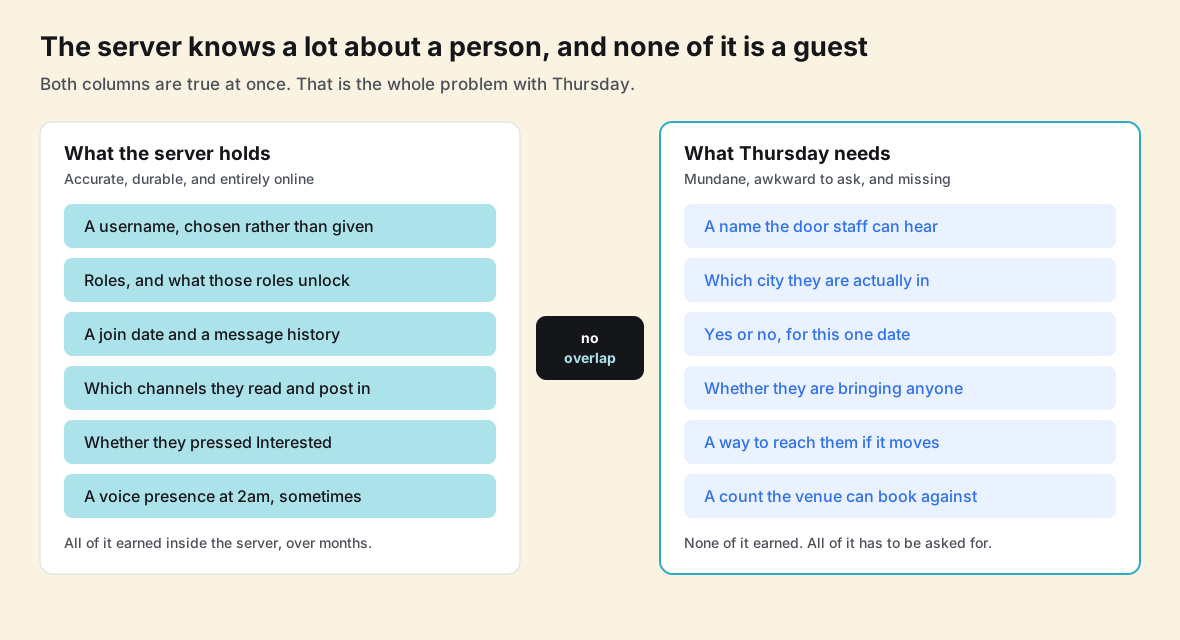
A server can tell you everything about a person except whether they will be in a bar on Thursday.
The question Interested is actually answering
Here is the hinge of the whole thing. Interested is a real signal, and it is not the signal an organiser needs.
Think about what a person is doing when they press it. They are saying the event sounds good, they would like to know when it starts, and they do not want to lose track of it.
That is closer to bookmarking than to promising. It costs one tap, it is reversible without embarrassment, and nobody ever gets a message asking why they pressed Interested and then did not show up.
Contrast that with an RSVP. An RSVP is a statement about your Thursday, made to a named person, that other people plan around.
The gap between the two is not laziness. It is that the button has been given a name that honestly describes a low cost signal, and organisers keep reading it as a high cost one.
We pull this apart in more depth in the piece on why Interested is not the same as attending, but the short version is this. A count of sixty Interested tells you the event was appealing. It tells you almost nothing about how many chairs to put out.
Why the button had to be called that
Discord did not choose the word carelessly. Most Discord events are online, and for an online event, Interested is precisely correct.
A voice channel does not need a headcount. Nobody books a table in a stage channel, nobody buys ingredients, and a stream with forty listeners instead of sixty is not a disaster.
For an online event, dropping in and out is normal behaviour rather than a broken promise. The feature is calibrated for that, and it should be.
The trouble starts when you point the same button at a physical room. The room has a capacity, a deposit, and a person standing at the door counting.
Server membership is not a social relationship
Now the harder idea, and the one most organisers resist.
Being in the same server with somebody is not, by itself, a relationship. It is a shared address.
You can spend two years reading the same channels as a person and never once have had a conversation that was about the two of you. That is not a failure of friendliness. It is what a many to many public space is.
Compare it to a WhatsApp group of nine friends. Everyone in that group has a private history with almost everyone else, and the group is a convenience on top of relationships that already exist.
A Discord server is the opposite. The space came first, and any relationships inside it are optional extras that some people have and most do not.
So when you post "drinks Thursday", you are not inviting friends. You are proposing a first meeting to a few hundred strangers who happen to share your taste in a game.
This distinction gets its own treatment in the difference between server membership and participation, because it changes what an organiser should expect from a headcount.
| What a plan needs | Friend group of nine | Server of four thousand |
|---|---|---|
| Knowing who is being invited | Everyone, obviously | Unclear, and the ambiguity is deliberate |
| A name for each person | Already known | A handle, and asking for more feels intrusive |
| Rough location | Known within a few miles | Could be anywhere on the planet |
| Social cost of not showing | High, you will hear about it | Near zero, nobody knows who you are offline |
| A way to chase a non-reply | A direct message that is normal | A direct message that reads as slightly odd |
| Shared assumption about the plan | Strong, built over years | None, everything must be stated |
Look down that right column. Every single row is work that somebody has to do by hand, and the server does not help with any of it.
The awkwardness nobody writes about
Ask a server organiser what the worst part is and they rarely say software. They say the asking.
Online identity is a genuine feature of Discord, not a workaround. People pick a handle, pick an avatar, and get to be a slightly different person in a place they chose.
Then an offline plan arrives and asks that person for their first name, their city, and possibly a phone number. Every one of those requests quietly dismantles the thing they liked.
Consider it from their side. Somebody they have never spoken to privately is asking, in public, whether they live near a specific bar.
That is a reasonable question and an uncomfortable one at the same time. Plenty of people simply do not answer, and their silence gets read as disinterest when it was actually discomfort.
There is a whole category of people who would come to the drinks and will never say so in a public channel. They are not shy about the event. They are unwilling to say where they live to a room of four thousand.
This is why the piece on running events without collecting contact details matters more in a Discord context than almost anywhere else. The privacy cost is the participation cost.
Time zones make the numbers lie
Every large server has this problem and most of them under-diagnose it.
A Scheduled Event shows each member the start time in their own local time. For an online event that is exactly right and it is one of the nicer touches in the feature.
For an offline event it produces a specific illusion. Sixty people press Interested, and roughly forty of them are on continents where attending would require a passport.
The organiser sees sixty. The bar will see the subset who could physically walk in, which nothing in the interface has ever measured.
Worse, the two groups are mixed together in the same list with no way to tell them apart. Interested from someone eight time zones away and Interested from someone two streets away are the same record.
Some servers solve this with regional roles, and that genuinely helps. It is also a manual system that only works if members self-assign accurately and keep it current when they move.
The Thursday that had sixty yeses and eleven people
Here is how it usually goes, compressed.
Monday, a moderator creates a Scheduled Event for Thursday at 8pm, location set to Elsewhere, with the bar name typed into the description. It looks great, because it is a real event object with a real date.
By Tuesday there are sixty Interested. The moderator, reasonably, tells the bar to expect around forty and pays a deposit on a large room.
Wednesday, someone asks in the general channel whether the bar has step-free access. The answer arrives, in that channel, forty messages below the question, and never makes it into the event itself.
Thursday afternoon, the start slides to 8:30pm because of a train strike. The moderator edits the event, which is the correct thing to do, and Discord does not push that change to everyone who pressed Interested.
Eleven people arrive. Two of them go to a different bar with a similar name, because the description said the street and not the number.
Nobody misbehaved in that story. Sixty people pressed a button that means what it says, and one moderator read it as something it never claimed to be.
Where the event object stops short
Discord's event is closer to a proper record than anything WhatsApp offers. It is worth being precise about where it stops.
The reference point here is the calendar standard the whole industry already agreed on. RFC 5545, published by the IETF in 2009, defines what an event object actually contains, including per-attendee status.
Its PARTSTAT field is the interesting one. It carries values like ACCEPTED, DECLINED, TENTATIVE and, by default, NEEDS-ACTION.
That default gives silence a name. Discord has no equivalent, because a server member who has not pressed anything is indistinguishable from one who never saw the event.
| Field | What it is for | Discord Scheduled Events |
|---|---|---|
DTSTART | One start time, zone aware | Present, and shown in each member's local time |
LOCATION | One current place | Present, but "Elsewhere" is free text you type |
ORGANIZER | Whose version is authoritative | Present, tied to the creator and Manage Events |
ATTENDEE | A named guest list | A subscriber count, not a named guest list |
PARTSTAT | Yes, no, maybe, or not yet answered | One state only, and no way to say no |
NEEDS-ACTION | Silence, made visible | Absent, silence looks like everything else |
SEQUENCE | Which revision you are holding | Absent, edits are quiet |
STATUS | Confirmed, tentative, cancelled | Present: scheduled, active, completed, cancelled |
Notice the pattern in the right column. Everything that describes the event is there. Everything that describes the people is thin.
That is not an oversight so much as a design centre. Discord built an event for a community, and a guest list is a different object with different privacy consequences.
The companion standard, RFC 5546 on scheduling requests and replies, defines the invitation and the answer as two halves of one exchange. Discord has a very good half of that. The reply half is a single optimistic button.
The channels problem, which is real but smaller
People often blame the channel structure, and it deserves some blame, just less than it gets.
Discord gives you plenty of room. Categories, channels, channel-level overrides and a permission system documented down to the individual bit. There is nothing stopping a server making a channel per meetup.
Threads look even better suited, because a meetup is exactly the kind of temporary side topic they were built for. Then you read how they age.
Discord's documentation on how threads archive is candid about it. Threads archive after a period of inactivity, and in busy servers that timer gets pulled in automatically as the guild approaches its cap on active threads.
A meetup planned four weeks out will therefore go quiet, archive, and need somebody to wake it up. The structure exists and it is tuned for conversations, which have a natural end, rather than plans, which have a date.
There is more on this in the article on keeping event details findable in an active server, because the volume of a busy server is its own force.
What actually works, in order
None of this means the drinks cannot happen. It means the organiser has to do a few specific things that the server will not do for them.
- Decide who is being invited before you post. "Everyone" is not a guest list, and posting to four thousand people is how you get sixty soft yeses and no headcount. Name the group: the London people, the regulars in one channel, the twelve who came last time.
- Use the Scheduled Event for what it is excellent at. It holds a real date, in everyone's local time, with the organiser attached. Create it, and treat it as the announcement rather than the guest list.
- Ask the attendance question somewhere else, and ask it properly. The question is not "does this sound fun". It is "are you coming on Thursday the 4th, yes or no".
- Make saying no cost nothing. If declining is invisible or awkward, people go quiet instead, and quiet is the one answer you cannot plan around. A named no is worth more to you than a soft maybe.
- Confirm the small number, not the big one. Two days out, contact the people who said yes and get a second confirmation. The drop between first yes and second yes is the number the venue actually needs.
- Put every change in one place people can re-read. Editing the event is right, but assume nobody was notified, and post the change where the yes-sayers will see it.
That fifth step is the one people skip and the one that saves the deposit. It feels like nagging. It is the difference between booking for forty and booking for twelve.
Why polls will not rescue this either
The instinct after a bad Thursday is to run a poll instead. Polls are good at one job and this is not it.
A poll closes a question at a moment. Attendance keeps changing after the poll closes, and the poll has no way to notice.
There is also a category error hiding in poll results, which the article on what polls measure versus what commitments measure takes apart. Voting that Thursday works is a statement about your calendar. Saying you will be there is a promise to a person.
Some vocabulary worth keeping straight
Half the confusion in this topic is four words being used for one thing.
- Member
- Somebody who joined the server. It says nothing about attention, location, or whether they have opened it since March.
- Participant
- Somebody who currently reads and posts. A useful number for community health and a poor predictor of offline turnout.
- Interested
- Somebody who pressed the button on a Scheduled Event. Discord defines this as letting the host know you would like to attend, plus a notification when it starts.
- Attendee
- Somebody who has said yes to one specific date and can be counted on for a booking. Discord has no field for this, which is the entire subject of this article.
Keeping those four apart is most of the fix. A server that reports Interested numbers to a venue is reporting the wrong column.
The pattern that fits Discord specifically
The move is not to abandon the server. The server is the reason these people know each other at all.
It is to stop asking one object to be both an announcement and a guest list. Those have opposite privacy requirements, which is why no single Discord feature can be both.
An announcement wants reach. It should go to the channel, it should be a Scheduled Event, and more eyes on it is straightforwardly good.
A guest list wants the opposite. It wants a small set of named people, a real yes or no from each, and no public record of who lives where.
So run both. The event stays in the server doing what it does well, and the attendance record lives at one link that only the people coming ever open.
This is the same structural point made in the comparison between Discord events and dedicated event pages, and in the broader argument for treating a conversation and an event object as different things.
| The announcement | The guest list | |
|---|---|---|
| Audience | As many as possible | As few as necessary |
| Success looks like | Lots of people saw it | A number you would bet money on |
| Right home | Channel plus Scheduled Event | One private link |
| Privacy | Public by design | Private by necessity |
| What a change costs | One edit, seen by whoever looks | One edit, seen by everyone affected |
| Silence means | Nothing, and that is fine | An open question you must chase |
Where Ontaym fits
This is the one section where we talk about our own product, and then we stop.
Ontaym holds the second column. An event is a record with one address, and you drop that address into your announcement channel like any other link.
Guests answer yes or no without joining anything, without an account, and without their details being visible to four thousand people. If it moves, you change it once and everyone who said yes is looking at the change.
Your server stays exactly as it is. Nobody migrates, nobody installs anything, and the community keeps happening where it already happens.
It is a narrow scope on purpose. A ticketed convention wants a ticketing platform, and a voice chat on Sunday wants a Scheduled Event and nothing else.
The one thing worth remembering
Discord is not failing at offline events because it is disorganised. It is one of the most organised social products in existence.
It struggles because a server is built to make joining cheap, and a Thursday needs somebody to make a promise. Cheap joining and firm promises are in tension by design.
Every good server has optimised hard for the first one. That optimisation is why the server has four thousand members, and also why eleven of them showing up feels like an achievement.
The fix is not more structure inside the server. It is one small thing beside it that only asks one question and remembers the answer.
Then the server can go back to what it is genuinely brilliant at, which is making four thousand people feel like they are in the same room. Getting eleven of them into an actual room is a different job, and it deserves a different tool.
Frequently asked questions
Does Discord actually have a proper events feature?
Yes, and it is better than most people give it credit for. Discord's documentation for the guild scheduled event object gives it a name, a description, a start and end time, a creator, a cover image, and a status field with four values. Its three entity types are stage instance, voice and external, and external is how a physical venue gets in there at all.
What does the Interested button actually mean?
In the interface it tells the host the event appeals to you and signs you up for a notification when it goes live. In Discord's data model it increments a field called user_count, which the documentation defines as the number of users subscribed to the event. It is not a promise about a specific Thursday, and it costs nothing to press or un-press.
Why is a server of four thousand harder to organise than a group chat of nine?
Because a group chat sits on top of relationships that already exist, and a server does not. In a friend group everyone knows everyone's name, rough location and social cost of not showing up. In a server, all three of those are unknown by default and have to be asked for one person at a time.
How do time zones distort the headcount?
Scheduled Events show each member the start time in their own local time, which is exactly right for an online event. For an offline one it means an Interested from someone two streets away and an Interested from someone eight time zones away land in the same undifferentiated list. Regional roles help, but only if members self-assign them and keep them current.
Why does asking for real-world details feel so awkward on Discord?
Because online identity is a genuine feature there, not a workaround. People choose a handle and an avatar, and an offline plan asks them for a first name, a city and sometimes a phone number in a public channel. Plenty of people who would happily come simply do not answer, and their silence gets misread as disinterest.
Can threads or a dedicated channel solve this?
Partly, and less than you would hope. There is plenty of room in a server for a channel or thread per meetup, and the permission system is fine-grained enough to control who sees it. The catch is that Discord's documentation describes threads archiving after inactivity, with that timer pulled in automatically in busy servers, so a meetup planned four weeks out goes quiet and archives well before the date arrives.
What is the single change that improves turnout most?
Confirming the small number rather than the big one. Two days before the event, go back to the people who actually said yes and ask for a second confirmation. The drop between the first yes and the second yes is the number worth telling the venue.
Does this mean moving the community off Discord?
No, and it would be a bad idea. The server is why these people know each other, and it should keep the announcement, the Scheduled Event and the conversation. Only the attendance record needs to live somewhere private beside it, at one link the people who are coming can open without joining anything.
Give your next plan one address instead of one more thread.
Plan it with Ontaym