
Why Messaging Apps Were Never Designed to Be Event Databases
You cannot ask a group chat what time you are meeting. You can only search for a word somebody might have typed. That difference sounds small, and it is why fourteen people end up at a park at two separate times.

Quick answer
A group chat is an append-only log: you can add to the end and nothing else. It has no schema, so facts are not labelled; no uniqueness constraint, so an old time and a new time sit side by side; and no index except the clock, so the important messages sink fastest.
Most importantly it has no query language. You cannot ask for the start time, you can only search for the wording somebody used, which requires guessing the answer in order to find it.
All of that is correct design for a chat app. The fix is not a better messenger but a second, small thing beside it: one event record with real fields, at one address, that every thread links to instead of retelling.
Try asking your group chat a question
Not a question for the people in it. A question for the chat itself.
Something like: what time are we meeting on Saturday? You cannot ask that. There is no box where that question goes.
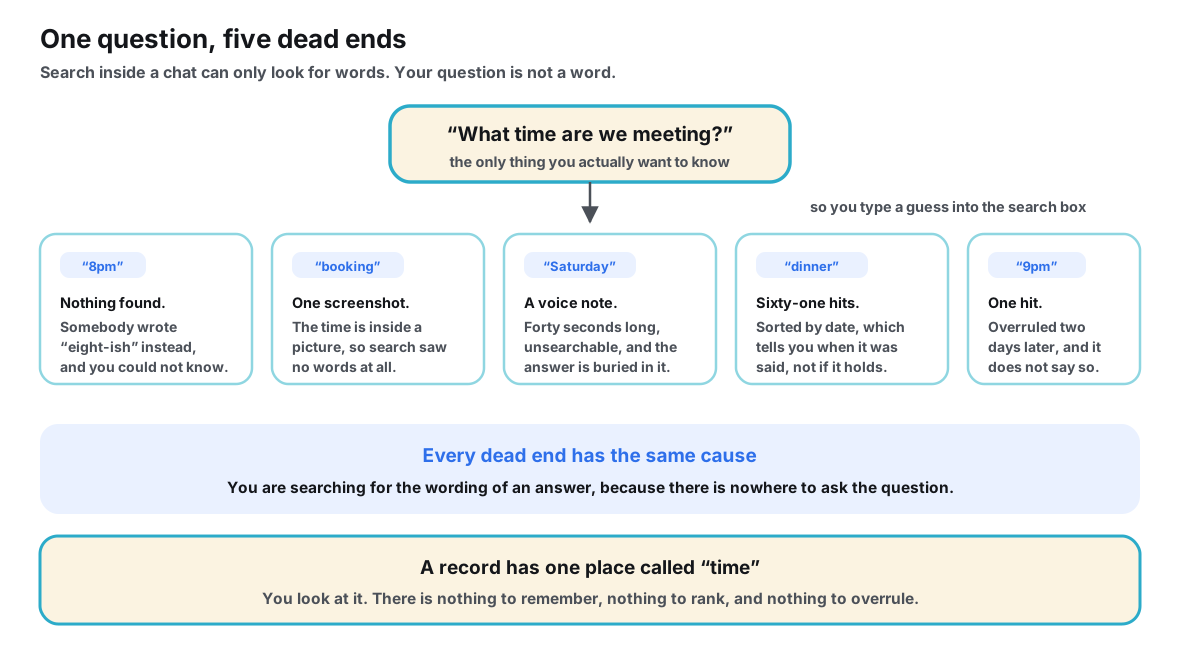
What you can do is search for a word. You can type "8pm" and hope somebody typed "8pm" rather than "eight-ish" or "same as last time" or a thumbs-up on a message that said it four days earlier.
That gap, between asking a question and guessing a word, is the whole subject of this article. It is not a bug in WhatsApp, and it is not laziness on Telegram's part.
It is what happens when you use a filing cabinet with no labels as a filing system. The cabinet is excellent. It was just never sold as a filing system.
A chat is a log, and a log is a very specific thing
Strip away the stickers and the read receipts and a group chat is one data structure: an append-only log.
Append-only means you can add to the end and nothing else. You cannot reach into the middle and change a value, because there are no values, only messages.
This is not a criticism. Append-only logs are one of the great designs in computing, and half the internet runs on them.
The catch is that a log is a record of events in the "things that happened" sense, not the "Saturday dinner" sense. It tells you what was said and when. It has no opinion about what is true now.
A log remembers everything and knows nothing.
Every plan you have ever made in a chat was made by a group of humans doing, by hand, the work that a database would have done for free. You just never billed anyone for it.
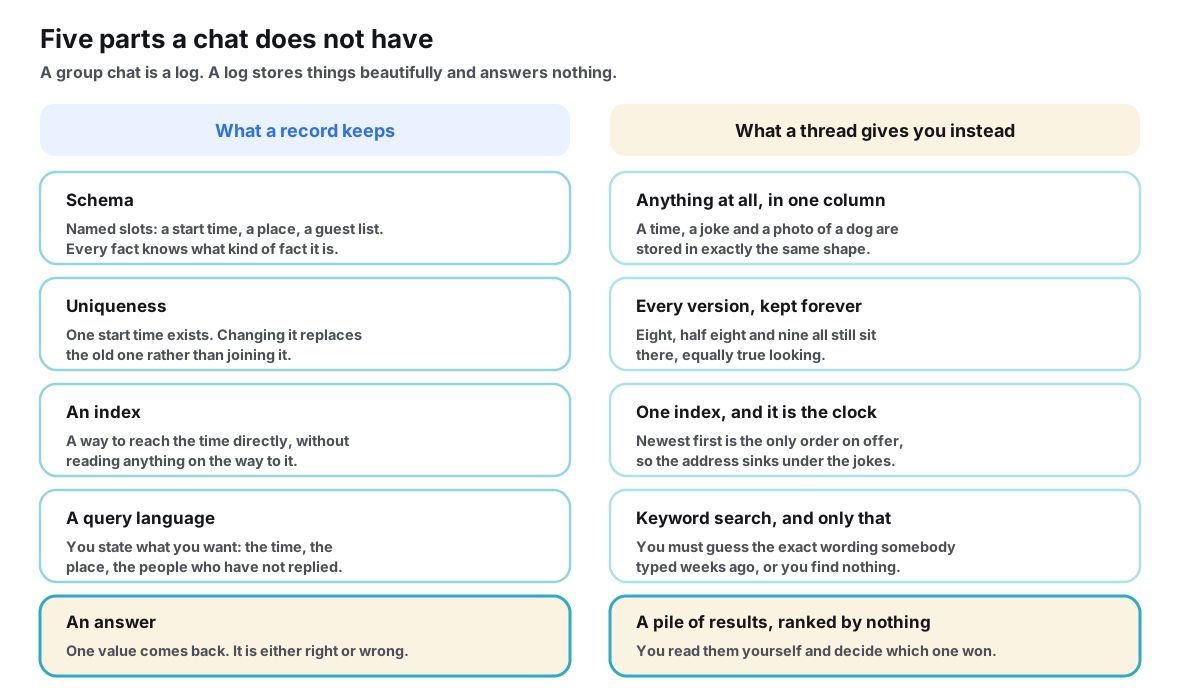
The five things a database has that your chat does not
Databases are boring on purpose. They are boring because they made five specific promises decades ago and then kept them.
Go through the five and you can watch your Saturday fall apart in slow motion.
A schema, which means facts know what they are
A schema is a set of named slots. This slot holds a start time, that one holds an address, that one holds a person's answer.
Because the slots are named, the software knows what it is holding. It can tell you the time is missing, because it knows there is supposed to be a time.
A chat has exactly one slot and it is called "message". A restaurant address, a photograph of a dog and the word "lol" all go into the same slot, in the same shape, with the same weight.
So nothing can ever be missing, because nothing was ever expected. Your group chat cannot notice that nobody has said where.
A uniqueness constraint, which means one fact wins
In a record, the start time is a single value. Change it and the old one stops existing.
That sounds obvious to the point of silliness until you watch a chat do the opposite. Move the dinner from eight to nine and the chat now contains both, sitting there with equal confidence, formatted identically.
Nothing marks the eight as dead. The only thing separating the true time from the false one is that one message is further down.
Ordering is a terrible way to store truth. It works perfectly right up until somebody scrolls, searches, or reads the thread out of order, which is to say it works until somebody uses it.
An index, which means you can get to something directly
An index is what lets you reach a fact without reading everything on the way. Look up "time" and there it is.
Chats do have an index. It is the clock, and it is the only one you get.
Newest first is a wonderful ordering for conversation, because conversation is about what is happening now. It is a catastrophic ordering for facts, because the address was posted on day one and the jokes never stop.
The most important message in the thread is the one that has been buried longest. That is not bad luck, it is the sorting working exactly as designed.
A query language, which means you can state what you want
This is the big one. A query is a description of the answer you want, and the system finds it.
You do not need to know where the answer lives, how it was worded, or who put it there. You say "the start time" and you get the start time.
Chat search is not a query language. It is string matching, which means you have to already know roughly what the answer looks like in order to find out what the answer is.
Read that again, because it is genuinely circular. Searching a chat requires you to guess the answer well enough to search for it.
An answer, which means one value comes back
Ask a database a question and you get a value. It is right or it is wrong, and either way there is one of it.
Search a chat and you get a list. Sixty-one messages containing the word "dinner", sorted by when they were sent.
The list is not an answer. It is homework.
What this actually costs a group planning a picnic
Abstractions are cheap. Let us spend a Saturday.
Fourteen people, a park, one of those plans that starts in April and happens in June. Somebody suggests it, everybody is delighted, and the thread does what threads do.
By the week of, the chat contains four candidate parks, two candidate times, a running joke about parking, one person's dietary requirements, a photograph of a gazebo, and around four hundred messages.
Every single one of those messages was true when it was sent. That is the part people miss when they blame the group.
| The question | In a record | In the chat | What actually goes wrong |
|---|---|---|---|
| What time? | Read one field | Search a guess, then judge the hits | Two people find different messages and both feel certain |
| Which park? | Read one field | Scroll for a map pin from six weeks ago | The pin was for the park that got rejected on Tuesday |
| Who is coming? | Count the answers | Count reactions, replies and silence by hand | Silence looks the same as yes, no and not looking |
| What should I bring? | One list, edited in place | Reassemble from nine scattered offers | Four people bring hummus and nobody brings cups |
| Has anything changed? | A modified date, visible | Reread from wherever you last left off | Late joiners confidently repeat old facts |
| Is it still on? | A status field | Interpret the last few messages for tone | "Probably" becomes a group-wide state of mind |
Notice the middle column. Every one of those is a person doing a lookup with their eyes.
Fourteen people times six questions is eighty-four private lookups, most of them repeated more than once. Nobody counts that as work, because it happens one person at a time, silently, usually on a bus.
This is also why the same question keeps coming back. It is not that people forget, it is that the details get buried faster than anyone can retrieve them, so asking a human is genuinely the cheapest option available.
Why searching inside a chat fails so specifically
People do try search. It is the obvious move and it fails in four reliable ways.
You have to remember the wording, not the fact
Search matches strings. Your memory does not store strings.
You remember that somebody settled the time. You do not remember whether they wrote "8pm", "8", "eight", "20:00", "after work" or "same as the last one".
So you guess. Guess wrong and you get zero results, which feels exactly like the fact not existing.
That last bit matters more than it sounds. A false empty result does not say "try different words", it says "nothing here", and people believe it.
Half the thread is opaque to search
Real group chats are not made of text. They are made of screenshots, voice notes, forwarded posts, shared map pins and photographs of handwritten lists.
Search cannot see inside any of that. A booking confirmation screenshot is, to the search box, a rectangle.
Voice notes are the purest example. Somebody explains the whole plan warmly and thoroughly in fifty seconds, and that plan is now stored in a format no one can scan, skim or quote.
The people who send the most helpful messages tend to send the least searchable ones. Effort and retrievability are, annoyingly, uncorrelated.
The results are ranked by nothing useful
Say your search works. You get sixty-one hits, sorted by date.
Date is not relevance. The most recent mention of "dinner" might be somebody saying they are sad they missed it.
What you want is the message that is currently authoritative, and no chat app knows which message that is. Neither does the message.
Nothing tells you a result has been overruled
This is the one that actually hurts. You find a message that says nine o'clock, and it says it clearly, from the organiser.
It does not mention that two days later the time moved back. A superseded message looks precisely like a current one, forever.
Confident wrong answers are worse than no answer. Someone with no information asks; someone with stale information simply turns up.
Now the important bit: this is the correct design
It would be easy to end here with a list of complaints. That would also be wrong.
Everything described above is a consequence of decisions that are right for a chat app. Reverse any of them and you would ruin the thing you actually love about your group chat.
A schema would make talking feel like filling in a form
Imagine a chat that required you to say what kind of message you were sending. Statement, question, joke, logistics, tentative suggestion.
Nobody would use it for five minutes. The reason chat feels effortless is that it demands nothing of you, and demanding nothing means understanding nothing.
Overwriting would be a betrayal of the medium
A database updates a value in place. A chat that did that would be deleting what people said.
You would scroll up and find your own words changed. The append-only log is not a limitation here, it is a promise: what you said stays said.
That promise is why a thread works as a conversation and why it will never work as a source of truth. The same property gives you both.
Chronological order is the point of a conversation
Sort a conversation by relevance and it stops being a conversation. Replies detach from what they replied to, jokes lose their setup, tone collapses.
Newest first exists because talking is about now. That is a feature so fundamental it barely looks like a decision.
Real query power would be a privacy nightmare
To answer "what time are we meeting", an app would have to read and understand your messages well enough to extract facts from them. Then it would have to keep those extracted facts somewhere.
For an end-to-end encrypted messenger, that is not a small feature request. It is an argument against the entire security model.
You can have a chat that understands your plans, or a chat that cannot read your messages. Most people, on reflection, would rather have the second one and just be a bit annoyed about parking.
| Design decision | Why it is right for chat | What it costs your Saturday |
|---|---|---|
| Append only, never overwrite | What you said stays said | Old times and new times coexist as equals |
| No schema, one message type | Zero friction, you just type | Nothing can be marked missing, because nothing was expected |
| Sorted newest first | Conversation reads in order | The most important facts sink the fastest |
| Search by keyword only | Simple, fast, works offline | You must remember phrasing to retrieve meaning |
| Any media, treated equally | Voice notes and photos feel natural | Half the plan is stored in unsearchable formats |
| End-to-end encryption | Nobody reads your group but your group | The app genuinely cannot extract a time for you |
Read that table twice. There is no column labelled "mistake".
Chat apps are not failing at event storage. They are succeeding at something else, and the two goals happen to be in direct opposition.
The thing you are missing already has a specification
Here is the part that annoys people slightly. The record your chat cannot hold was standardised before most of these apps existed.
It is defined in the IETF specification behind every .ics calendar file, published in 2009. It is a schema, in the boring, useful sense.
An event has a UID, which is a permanent address. It has DTSTART and DTEND, a LOCATION, an ORGANIZER and a list of ATTENDEE entries.
Each attendee carries a PARTSTAT, their participation status, and the default value is NEEDS-ACTION. Silence has a name, which is more than your group chat manages.
There is also SEQUENCE, a revision number, and LAST-MODIFIED, a timestamp. Those two exist purely so that a plan can change without anyone having to work out whose copy is older.
A companion specification, the IETF's scheduling protocol for invitations and replies, defines how a REQUEST goes out and a REPLY comes back. The whole shape has been sitting there for well over a decade.
The point is not that you should send your friends .ics files. The point is that nobody needs to invent what a stored event looks like, because the difference between a conversation and an event object was settled long ago by people who were not thinking about picnics at all.
Six symptoms that mean a human has become the database
Groups do solve this. They solve it with a person, usually the same person, usually without ever discussing it.
Here is how to spot it happening.
- The same question returns for the third time. "What time again?" is not forgetfulness. It is a group discovering there is nowhere to look, one member at a time.
- Someone keeps a private list. If the real headcount lives in one person's notes app, congratulations, your group has a database and it has a bedtime.
- Two messages say "FINAL". Two finals in one thread is state being faked with repetition, and repetition is how drift starts.
- Somebody screenshots the chat to send to somebody else. That is a person manually exporting a record, because there is no record to link to.
- A newcomer needs a briefing. If joining on day ten means asking a human to summarise, the information is present but not reachable, which is the same as absent.
- Someone turns up at the wrong time or place. This is the one the other five were quietly predicting.
Two of these and etiquette will not save you. Better manners raise the ceiling; structure removes it.
The private list is the most telling symptom, because it is the group unconsciously building the missing table. Someone has looked at the thread, concluded it cannot be queried, and started keeping the real attendance count somewhere else entirely.
Why the usual patches only get you so far
Every group invents the same three workarounds, and all three are better than nothing.
Pinning a message
Pinning is the closest a chat comes to an index. You are marking one message as more important than the clock says it is.
The limit is that a pin is a photograph, not a field. When the plan changes, the pin is either stale or manually replaced, and everyone who read the first version now holds old facts with total confidence.
A pin also cannot tell you who is coming, what changed, or how old it is. It is one string, frozen.
Running a poll
Polls are the only real structured data most chat apps offer, and they are genuinely good at what they do. Three dates, one winner, decision closed.
The trouble is that a poll answers a question at a moment and then stops. Attendance keeps moving for weeks after the votes stop counting, which is why saying you are going is not the same as answering a poll.
A poll is also a different question than the one you think you asked. "Saturday works for me" is a statement about your calendar. "I am coming" is a promise about your Saturday.
Reacting with an emoji
The thumbs-up is the most efficient social signal ever invented and the worst attendance record ever kept. It means yes, maybe, I saw this, I approve, and I am being polite, all with the same pixels.
Count them and you have a number. You do not have a guest list, which is why reactions make such unreliable attendance records.
Reactions also attach to a message, not to an event. React to the message announcing eight o'clock and your thumb stays there after the time changes, still pointing at a fact that expired.
What a record does that a thread structurally cannot
The fix is not a better chat app. It is a second thing, sitting next to the chat, doing the job the chat was never built for.
A record is one address. The plan lives there, and the thread links to it rather than retelling it.
That distinction matters more than it sounds. Repeat a fact in a thread and you have made a second copy that can drift out of date; point at the record and there is nothing to drift from.
The record can answer questions because it has fields. Ask it for the time and it has a time, singular, current, with a date attached saying when it last changed.
It can also tell you what it does not know. Nobody has answered yet is a state a record can hold and a thread cannot, because a thread has no way to represent an absence.
None of this requires your group to move house. The conversation stays exactly where it is, and this only works because neither chat apps nor event platforms were ever going to fill that middle layer on their own.
How to do it by hand this week
Suppose the picnic is on Saturday and philosophy is not helpful right now. There is a manual version that works.
Read the thread once, end to end, and write down what is currently true. Do it privately and do it properly, so that nobody else has to do it again.
Post that as one clearly formatted message and pin it. One pin, not four, and resist the urge to also pin the map and the menu.
From then on, answer every question with a pointer rather than a restatement. It feels curt for a day and then it feels like relief.
When something changes, edit or replace the pin rather than adding to it. The moment two pins coexist you have rebuilt the original problem, one storey up.
This genuinely works. It is also a person performing a database's duties unpaid, which is fine for one picnic and grim as a lifestyle, so it is worth knowing what a real single source of truth looks like before the next one.
Where Ontaym fits
Ontaym exists to be the record, which is the honest reason this article exists at all.
An event is a page with fields rather than a thread with history. One time, one place, one guest list, one address you can drop into any conversation on any platform.
Guests answer without making an account and without swapping phone numbers with everyone else on the list. Your group chat stays exactly where it is, doing the thing it is genuinely good at.
That is a deliberately narrow scope. A ticketed conference wants a publishing platform, and coffee with one friend wants nothing at all.
The one sentence worth keeping
If you take nothing else from this, take the diagnosis rather than the complaint.
When planning feels harder than the event deserves, stop asking which chat app is best. Ask whether the hard part is talking or remembering.
If the hard part is deciding, arguing or getting people excited, that is conversation, and your chat is already the right tool. Leave it completely alone.
If the hard part is that nobody can find the time, or the headcount lives in one person's head, that is storage. No amount of better messaging produces storage.
Your group chat is not bad at being an event database. It is superb at being a chat, and those two sentences describe the same design.
Frequently asked questions
Why can I not just search my group chat for the event details?
Because chat search matches words, not meaning, so you have to already know how somebody phrased the answer in order to find it. Guess wrong and you get an empty result that looks identical to the fact not existing. Anything stored in a screenshot, a voice note or a shared map pin is invisible to search entirely.
What does it mean to say a group chat is an append-only log?
It means messages can only be added to the end, never changed in place. That is why moving a dinner from eight to nine adds a message rather than replacing a value, and both times stay in the thread looking equally true. The only thing marking the newer one as correct is that it sits further down.
Is this a flaw in WhatsApp or Telegram that they could fix?
No, and fixing it would make them worse chat apps. Overwriting messages would break the promise that what you said stays said, a schema would turn typing into form filling, and extracting facts automatically would require reading messages that end-to-end encryption is specifically designed to keep unreadable.
Does a pinned message solve the problem?
Partly, and it is the best move available inside a chat. A pin is a frozen photograph of the plan rather than a live field, so when things change it is either stale or manually swapped. It also cannot say who is coming, what changed, or how old it is.
Why are polls and emoji reactions not a real attendance record?
A poll closes one question at one moment, while attendance keeps moving for weeks afterwards. A thumbs-up means yes, maybe, I saw this and I am being polite, all with identical pixels. Both also attach to a message rather than to the event, so they survive unchanged after the fact they refer to has expired.
What should an event record actually contain?
The IETF settled this in RFC 5545 back in 2009: a permanent identifier, a start and end time, a location, an organiser, and each attendee with their own participation status. It also includes a revision number and a last-modified timestamp so a plan can change without anyone guessing whose copy is older.
How do I know my group has outgrown the chat?
Watch for the same question returning a third time, someone quietly keeping the real headcount in a notes app, two messages both announcing final details, and newcomers needing a human to brief them. Any two of those mean a person has become the database. Group size matters far less than how chatty the group is.
Do I have to move my friends to a different app?
No, and that would be the wrong fix. The conversation stays exactly where it already happens, and only the facts move to a single record with one address that any thread can link to. Guests read and answer it in a browser without installing anything.
Give your next plan one address instead of one more thread.
Plan it with Ontaym