
The Missing Layer Between Telegram Communities and Offline Events
Telegram gives a community more coordination tools than any other messaging app: groups of 200,000, channels with no subscriber ceiling, topics, visible-vote polls, pins and a full bot platform. And the community still cannot tell you who is coming on Saturday. That gap is not a missing feature.

Quick answer
Telegram is the best-equipped messaging app for running a large community, and the gap between an online group and an offline event survives all of it. Supergroups, channels, topics, polls, pins and bots are all excellent at moving messages and none of them hold a fact.
At scale, membership stops resembling a guest list. Twelve thousand members produce two hundred reactions, eighty-eight poll votes and twenty-six people in a field, and the chat can show you every one of those numbers except the last.
What closes the gap is a record rather than a feature: one current time, one current place, and a per-person answer that can change. Give the plan one address, keep the community exactly where it is, and let every thread point at it.
Twelve thousand members, twenty six people in a field
A photography community on Telegram announces a sunrise walk. The group has twelve thousand members, and the announcement gets two hundred reactions inside an hour.
On the Saturday, twenty six people stand in a field at nine in the morning. The organiser had booked a minibus for forty.
Nobody lied. Every one of those two hundred reactions was a genuine, warm, well meant thumbs up from someone who was not going to be in that field.
Here is what makes this interesting rather than obvious. Telegram is not a thin app that forgot to build coordination tools.
It is the most feature-rich messaging platform in wide use, with more machinery for organising a crowd than any of its competitors. And the gap between the group and the field survives all of it.
That is the story worth telling. The missing piece was never a feature.
Just how much machinery there is
Start with size, because size is where Telegram made its name. According to Telegram's own FAQ on groups and channels, a group can hold up to 200,000 members.
That is not a typo, and it is not the theoretical ceiling either. The underlying API documentation on channel and group types explains that a basic group tops out at 200 members and is promoted to a supergroup beyond that, and that gigagroups exist to carry broadcast-style communities past even the 200,000 mark.
Then there are channels, which the same FAQ describes as a broadcasting tool with an unlimited number of subscribers. So the platform gives you a room for two hundred, a room for two hundred thousand, and a megaphone for everyone.
On top of that sits the coordination layer proper. Topics split one busy group into separate threads with their own history and notification settings, which Telegram introduced in its announcement of Topics in groups.
Polls are unusually good. Telegram's Polls 2.0 announcement added visible votes, multiple answers and a quiz mode with a correct option.
Pinned messages sit at the top of the chat. Bots run inside conversations and, per the FAQ, can open full mini apps with their own interface.
Add admins, granular permissions, slow mode and message signatures, and you have something closer to a community operating system than a chat app.
Telegram did not fail to build coordination tools. It built more of them than anyone, and the plan still lives in one person's head.
What scale actually does to a plan
Most writing about big group chats treats size as a volume problem. Too many messages, too much noise, mute the thing and move on.
Volume is the visible symptom. The real damage is that scale destroys the relationship between the group and the guest list.
In a group of nine, membership is roughly the same thing as invitation. If you are in the chat about Saturday, you are invited to Saturday, and the organiser can hold all nine names in their head.
At twelve thousand, those two things have nothing to do with each other. Membership is a historical fact about a tap someone made eighteen months ago.
The organiser is now trying to find twenty or thirty specific humans inside a crowd that has no shape. And the only instrument the room provides is a broadcast.
The five numbers problem
Every large community event has at least five different populations, and they get confused with each other constantly.
There are the members, who joined. There are the people who saw the announcement, which is a much smaller number once you account for mutes and timing.
Then the people who reacted, the people who voted in the poll, and finally the people who came. Each number is a fraction of the one above it, and the drop is not gentle.
A group chat can show you the first four. It has no representation whatsoever for the fifth.
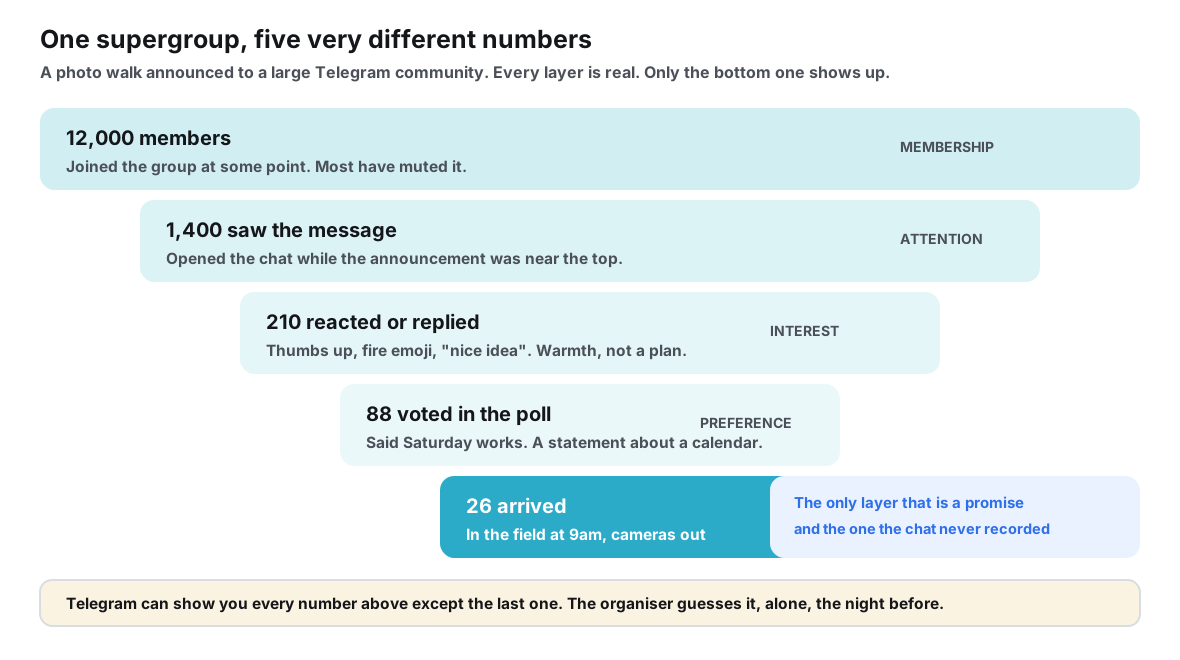
This is why organisers of big communities develop a private folklore about ratios. "Take the poll number and halve it" is real advice that real people give each other.
It is also an admission of defeat. Estimating from a proxy is what you do when the actual quantity is unmeasurable.
Channels and groups, honestly
The channel versus group choice is the first thing every Telegram community argues about, and both sides are right.
A channel is for broadcasting. The organiser posts, everyone reads, nobody replies over the top of the details.
That solves the burial problem beautifully. Announce the walk in a channel and it stays legible, because there are no jokes underneath it.
What a channel cannot do is hear anything back. You have created a perfect notice board and removed every way for a person to say "I am coming".
So communities do the sensible thing and run both, usually a channel with a discussion group attached. Now the announcement lives in one place and the responses live in another.
Which is genuinely better, and also splits your plan across two rooms. The definitive detail is in the channel, the current reality is in the group, and neither one knows about the other.
| What the plan needs | Channel | Group or supergroup |
|---|---|---|
| Reach everyone once | Excellent, that is the whole design | Good, until the message scrolls |
| Stay findable a week later | Good, the post stays near the top | Poor, unless somebody pins it |
| Collect a reply from a person | Not possible without a linked group | Yes, mixed with everything else |
| Know who is coming, by name | No mechanism | Only by hand, by one human |
| Cap attendance at forty | No mechanism | No mechanism |
| Update the time everywhere | Edit the post, silently | New message, or edit nobody notices |
| Tell a newcomer what is true now | They scroll the archive | They ask, and someone retypes it |
Look down that table and notice the pattern. Both columns are strong on distribution and empty on state.
That is not a criticism of either. Distribution is what both were built for, and both do it better than almost anything else on a phone.
If you are still deciding between them, the longer version of that argument lives in our piece on whether channels or groups suit event announcements better. The short answer is that the choice matters less than people think, because the missing piece is in neither.
What a poll closes and what it does not
Telegram polls deserve real credit. Visible votes alone put them ahead of most competitors, because you can see which named person picked which option.
That sounds like it should solve attendance. Name plus answer is most of what an attendee list is.
Here is where it comes apart. A poll answers the question it asked, and the question it asked was almost never "are you coming".
"Which Saturday suits you?" is a question about a calendar. Answering it costs nothing and commits to nothing, which is exactly why so many people answer.
Even a poll that literally asks "are you coming" has a shape problem. It closes at a moment, and attendance keeps moving for the fortnight afterwards.
Someone who voted yes in week one gets a shift on the Friday. There is no way for that person to change their vote in a manner anyone will notice, so they either send a message that scrolls away or they simply do not turn up.
The vote is a record of a past intention. Nobody needs a record of past intentions.
| Question | Closest Telegram feature | What it gives you | What is still missing |
|---|---|---|---|
| When should we do this? | Poll with multiple answers | A genuinely good decision | Nothing, this one works |
| Where and when is it now? | Pinned message | One post at the top | Age, revision, and whether it is current |
| Who is actually coming? | Poll with visible votes | Names attached to a past click | Any way to change an answer later |
| Is there still a space? | Bot with a counter | A number someone coded | A record that survives the bot |
The first row is the honest one. For choosing a date, a Telegram poll is close to perfect and you should keep using it.
The other three rows are where the trouble is. We took the gap between a vote and a commitment apart in more detail in the piece on why poll results are not an attendance list, and the same distinction turns up in saying you are going versus answering a poll.
The thing bots can and cannot fix
At this point every experienced Telegram organiser says the same thing. Use a bot.
They are right that bots are powerful. Telegram's bot platform is the most capable in messaging, and a bot can absolutely take names, count places, close a list at forty and message everyone who signed up.
People have built exactly that, many times over. So why is the field still half empty?
Because a bot solves the interface problem and not the structure problem. It gives you a place to put an answer, and the answer still lives inside one chat platform, in one bot's private database, owned by whoever is paying for the hosting.
Four things a bot cannot do for you
None of these are complaints about bot developers. They are consequences of where a bot sits.
- Reach the half of your group that is not on Telegram. Most real communities have people on WhatsApp, on Signal, or on nothing but email.
- Outlive its maintainer. When the volunteer who wrote it gets busy, the attendance history goes with them.
- Be read by anything else. The signup list cannot open in a calendar, a spreadsheet, or the venue's booking system.
- Be trusted by a newcomer. Starting a private chat with an unknown bot is a real ask, and a chunk of any group will not do it.
That last one is underrated. Every extra step between "I want to come" and "the organiser knows I am coming" costs you people, and it costs you the shyest people first.
A bot also asks the community to install a bespoke workflow before they can attend a walk. That is fine for a group that meets weekly and knows the drill, and it is a real barrier for the person who lurked for a year before deciding to show up.
Why the features do not add up
Here is the underlying reason, and it is the same reason in every messaging app. It just shows up most clearly in the one with the most features.
A chat platform stores history. A plan is state.
History is an ordered list of everything anyone said, kept forever. State is the handful of facts that are true right now.
Every Telegram feature listed at the top of this article is a history feature. Topics organise history, pins highlight a piece of it, and polls freeze a moment of it with names attached.
None of them replace a fact. When the walk moves from nine to ten, the nine does not go anywhere, and nothing on screen marks it as dead.
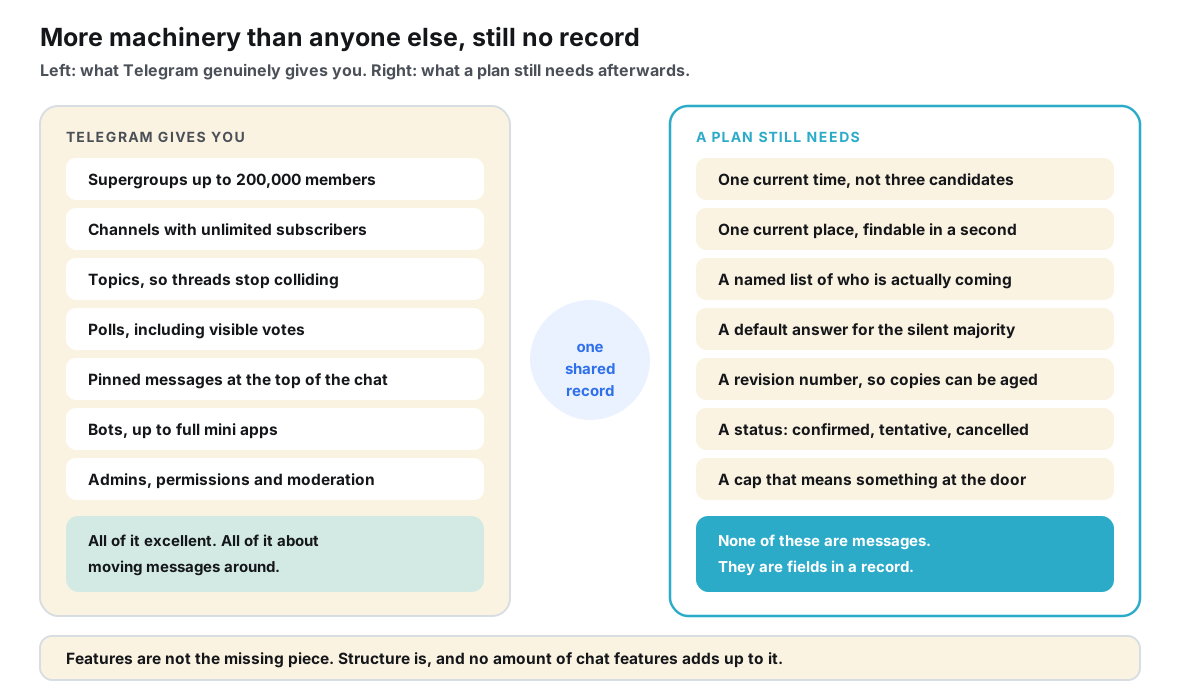
What the right column describes has a name and a specification. The IETF standardised it in RFC 5545, the iCalendar format, back in 2009.
It defines an event as named fields: a start and end time, a location, an organiser, each attendee with a participation status, a revision number and a last-modified timestamp. That is the file that opens on every phone you have ever owned.
The field that matters most here is the participation status attached to each attendee, whose default value is NEEDS-ACTION. It gives silence a name.
In a supergroup of twelve thousand, the person who has not answered is indistinguishable from the person who is coming, the person who is not, and the eleven thousand people who muted the group in 2024. A record separates them by default.
There is a companion specification, RFC 5546, which defines how invitations and replies travel. So the invitation and the answer were both formalised over fifteen years ago.
We pulled this thread properly in the difference between a conversation and an event object. The short version is that a message can contain a fact but cannot hold one.
Why not just send everyone a calendar invite
Fair question, given that the standard has existed for so long. The answer is that calendar invitations grew up in offices and carry office assumptions.
They assume you have a findable address for every guest. A Telegram community has usernames, and usually not much else, which is rather the point of it.
They assume everyone's app behaves. Mostly it does, and mostly is fatal when eight people in a hundred cannot open the file.
They also assume the tone is acceptable. Nothing drains the fun from a sunrise photo walk quite like a meeting request.
None of that is a flaw in the standard. The standard got the shape of the record exactly right and then handed it to software built for quarterly reviews.
Why event platforms are the wrong size too
The other obvious answer is to put the walk on a proper event platform. Those genuinely hold a record: one time, one place, a guest list, a way to answer.
They also assume you want an audience. Discovery, promotion, tickets, a public page that strangers can find.
A Telegram community already has its audience. The whole problem is the opposite one: converting an audience you already have into a countable group of people who will be somewhere on Saturday.
So the organiser opens the event platform, finds a form asking for ticket types and refund policies, and closes it again. Then they go back to the group and post the details as a message, which is a completely rational decision.
That is the loop that never breaks. This is the same shape we described in the missing layer between messaging apps and event platforms, and Telegram is simply its most vivid case.
The mismatch, laid out
Put the two neighbours side by side and the missing piece describes itself.
It needs the fields of a record, because otherwise it is just a better-behaved message. It needs to be private by default, because the guest list is the audience.
It needs to cost the guest nothing, because a community that lurks will not install anything to say yes. And it needs to leave the conversation completely alone, which is the requirement everyone skips.
That last one deserves saying plainly. Nobody wants to move their community off Telegram, and nobody should.
A Telegram community is often a genuinely good place to be. Twelve thousand photographers who talk about lenses at midnight are not a distribution problem to be solved.
The chat is not the enemy of the plan. It is just the wrong container for four specific facts.
What to actually do on Monday
If you run a large Telegram community and you want more than twenty six people in the field, there is a sequence that works. It does not require anyone to leave, and it does not require a bot.
- Keep the poll for the date. This is the one thing Telegram polls do perfectly. Ask which Saturday works, let people pick several, close it, and never mention the vote count again.
- Separate the decision from the commitment. The moment the date is chosen, stop treating poll voters as attendees. They answered a different question and they know it.
- Give the event one address. Put the current time, place and answer mechanism in one place that lives outside the chat and can be linked to.
- Announce with a pointer, not a paragraph. Post one message with the hook and the link. Every subsequent question gets answered with the same link rather than a retyped detail.
- Let people answer where they are. Anyone who opens the link should be able to say yes without joining anything, installing anything, or revealing a phone number.
- Change the record, not the thread. When the start time moves, edit the record once. The thread stays for excitement and lift-sharing, which is what it is good at.
Step four is the one that feels wrong at first. Organisers instinctively retype the details every time someone asks, because it feels rude not to.
Repeating a fact in a thread creates a second copy that can drift out of date. Pointing at the record creates nothing that can drift.
If you want the mechanics of that in a Telegram-shaped setting, we walked through it in organising event information inside a Telegram group.
The objections worth taking seriously
"We just pin the message"
Pinning is the correct first move and you should keep doing it. Its limit is that a pin is a photograph, not a record.
When the time changes, the pin is either stale or quietly swapped. Anyone who read the first version now holds old facts with complete confidence, which is worse than holding none.
A pin also cannot tell you how old it is, what changed, or who is coming.
"Our community is too big for RSVPs to mean anything"
This is the most common one, and it has the logic backwards. A large community is exactly where an answer mechanism starts to matter, because you cannot hold the names in your head.
You are not asking twelve thousand people to RSVP. You are giving the forty who will actually come a way to say so.
The other eleven thousand nine hundred and sixty do nothing, which is what they were always going to do anyway.
"Reactions are good enough for a rough count"
Reactions are excellent social signals and terrible attendance data. A thumbs up on an announcement means "I like that this exists", which is a different sentence entirely.
The gap between the two is where every over-booked minibus comes from. We looked at that specific confusion in why emoji reactions do not make attendance records.
"A bot already does this for us"
Then you have solved the interface and should keep it. Check whether the answers are readable by anything except the bot, and whether they survive the person who maintains it losing interest.
If both answers are no, you have a working process with a single point of failure. That is fine for a monthly walk and uncomfortable for anything a venue is holding a deposit for.
The vocabulary that makes this easier to argue about
Half the confusion in community organising comes from four words being used interchangeably. They are not interchangeable.
- Member
- Someone who joined the group. Says nothing about attention, interest or availability, and at scale says almost nothing at all.
- Reach
- Someone who saw the message. A function of mute settings and timing, entirely outside the organiser's control.
- Interest
- Someone who reacted, replied or voted. Real and worth having, but a statement about feelings rather than a Saturday.
- Commitment
- Someone who said they will be there, to a record that can be counted and changed. The only one you can book a minibus against.
Say "we had two hundred interested and twenty six committed" and everyone in the conversation immediately understands the situation. Say "we had two hundred people interested" and half the room hears a headcount.
The distinction between belonging to a community and turning up to its events is worth naming out loud, which is why we gave it a whole article in how Telegram communities turn into real-world meetups.
Where Ontaym fits
Ontaym is built for that middle layer, which is the honest reason this article exists.
An event is a record rather than a message. It has one address you can drop into a Telegram group, a channel, a discussion thread or all three at once.
Guests answer by opening a link. No account, no bot, no phone number handed to eleven thousand strangers.
Your community stays exactly where it is. The lens arguments at midnight are not something anyone should be trying to migrate.
It is a deliberately small scope and it is not right for everything. A ticketed conference belongs on a publishing platform, and three friends meeting for coffee need nothing at all.
What this actually tells you
Telegram is the strongest possible test of a simple idea, which is why it is worth writing about.
If more coordination features closed the offline gap, Telegram would have closed it years ago. It has supergroups, channels, topics, visible-vote polls, pinned messages and a full bot platform.
The gap is still there, in every large community, every time. Which means the missing piece was never a feature at all.
The missing piece is a record: one time, one place, one organiser, and a list of people who said they are coming, changeable right up until the morning.
Give the plan an address. Let the group keep talking, because the talking was never the problem.
Frequently asked questions
How many members can a Telegram group have?
Telegram's own FAQ states that groups can have up to 200,000 members each. The API documentation adds that a basic group holds a maximum of 200 members before it becomes a supergroup, and that gigagroups exist for broadcast-style communities that outgrow even 200,000.
Should a community use a Telegram channel or a group for events?
A channel keeps the announcement legible because nobody can reply over the top of it, but it gives people no way to say they are coming. A group collects replies and buries the details. Most communities run both, which works and also splits the plan across two rooms.
Do Telegram polls tell you who is attending an event?
They tell you who voted, which is not the same thing. A poll asking which Saturday suits people is a question about calendars, and even a poll asking directly about attendance closes at a moment while attendance keeps moving for a fortnight afterwards.
Can a Telegram bot solve event RSVPs?
A bot can absolutely take names, cap a list and message everyone who signed up, and Telegram's bot platform is the most capable in messaging. What it cannot do is reach people who are not on Telegram, outlive the volunteer maintaining it, or produce a record any other software can read.
Why do so few people turn up compared with the reactions on an announcement?
Because a reaction means 'I like that this exists', not 'I will be there'. Every large community event has separate populations for members, reach, interest and commitment, and only the last one predicts attendance.
Does fixing this mean moving my community off Telegram?
No, and it would be a bad idea. The community is worth keeping exactly where it is; only four facts need to live somewhere else, namely the current time, the current place, who is coming and whether anything changed.
Is a pinned message good enough to hold the details?
Pinning is the right first move inside a chat and it still falls short. A pin is a photograph of the plan at one moment, so when things change it is either stale or silently swapped, and it can never tell you how old it is or who is coming.
Has anyone standardised what an event record should contain?
Yes. RFC 5545, published by the IETF in 2009, defines the event behind every calendar file: start and end time, location, organiser, each attendee with a participation status, a revision number and a last-modified timestamp. RFC 5546 defines how the invitation and the reply travel between people.
Give your next plan one address instead of one more thread.
Plan it with Ontaym