
Why WhatsApp Groups Become Messy When Planning Events
Every group has one: the planning thread that ate a fortnight. It is not caused by disorganised friends or a badly run group. It is caused by six specific things a chat does on purpose, each of which is correct for talking and wrong for holding a plan.

Quick answer
WhatsApp groups get messy because a thread keeps history rather than state. Move a dinner from 8pm to 8:30pm and both times stay in the group, ranked only by which arrived last.
Five more things pile on top. Recency is the only ordering, four topics share one lane, replies are ambiguous as answers, every update interrupts everybody, and size multiplies all of it.
Pins, polls, recaps, announcement groups and WhatsApp's own in-chat events each fix one mechanism and leave the rest. What actually closes it is keeping the conversation where it is and giving the plan one address that the thread links to.
The group is called "Priya 40 FINAL"
It was called "Priya 40" for about nine days. Then somebody renamed it, which tells you everything about how the nine days went.
Twenty-three people. One birthday dinner. Four hundred and something messages, of which maybe fourteen contained a fact anybody needed.
You already know this group. You have been in this group, possibly this week.
Here is the thing worth saying out loud before anything else. Nobody in that thread did a single careless thing.
Every message was true when it was sent. Every person was trying to be helpful, or funny, or both. The mess arrived anyway, on schedule, the way it always does.
That is the tell. When a bad outcome survives everybody behaving well, you are not looking at a people problem.
WhatsApp is extremely good at its actual job
Let us get this settled early, because the rest of the article is a list of complaints and they will read as unfair otherwise.
WhatsApp is a superb messaging app. It is fast, it is end to end encrypted, it works on an ancient phone on a bad connection, and it does not make your nan create an account with a password.
It is also the reason a group of twenty-three people can exist at all. Try assembling those twenty-three anywhere else and watch six of them never arrive.
The trouble is that nobody set out to plan a birthday in a messaging app. They set out to mention a birthday, and the plan grew there because that was where everyone already was.
So what follows is not a criticism of the software. It is a description of what happens when a tool designed to carry talk is asked to carry a record.
A thread is a brilliant place to decide something and a terrible place to have decided it.
Mechanism one: it keeps history, not state
This is the root of all the others, so it is worth being precise.
History is the ordered list of everything anyone said. State is the short list of things that are true at this moment.
A chat is a history. It is very good at being one.
When Priya's dinner moves from 8pm to 8:30pm, the thread does not update. It appends.
Both times are now in the group, both rendered identically, both equally real as objects on a screen. The only thing marking one of them as dead is the fact that it appears higher up.
Nothing in the interface says "superseded". Nothing greys out the old time. The eight and the half eight sit there like two equally confident witnesses.
That is why two careful people can read the same thread and turn up half an hour apart. Neither of them misread anything. They just stopped scrolling at different points, which is not a moral failing.
This is exactly the gap that sits between messaging apps and event platforms, and everything below is a symptom of it.
Mechanism two: newest is the only ranking
Ask yourself how a chat decides what to show you at the top. It does not decide. Time decides.
There is no notion of importance, no pinned-by-relevance, no "this message contains the address". A message about the address and a message containing a single crying-laughing emoji are ranked by exactly one criterion, and it is not usefulness.
Which means the address sinks. It sinks at the speed of the group's sense of humour, and a good group has a fast sense of humour.
The nastiest version is the useful message posted on a Friday night. Twelve people are awake, feeling chatty, and the venue link is forty messages down before anyone sober reads it.
Now compare that to how you find anything else. In a calendar you look at the date, and in an email you search the subject.
In a chat you scroll. Scrolling is a search method with no query.
Search does exist, and it is genuinely decent. It fails here for a specific reason: you have to already know a word from the message you have lost. If somebody typed the restaurant name and you only remember "that Italian place", search has nothing to give you.
This is why the details end up buried rather than deleted. They are all still there. They are just not reachable in the three seconds a human is willing to spend.
Mechanism three: four conversations, one lane
Watch a planning thread closely and you will notice it is not one conversation. It is four, interleaved, sharing a single queue.
There is the date conversation and the venue conversation. There is the logistics conversation, which is lifts and dietary requirements and whether the 6.15 train is a mistake.
And there is ordinary chatter, which is the entire reason the group is nice to be in.
All four take turns in one lane. None of them can be followed on its own.
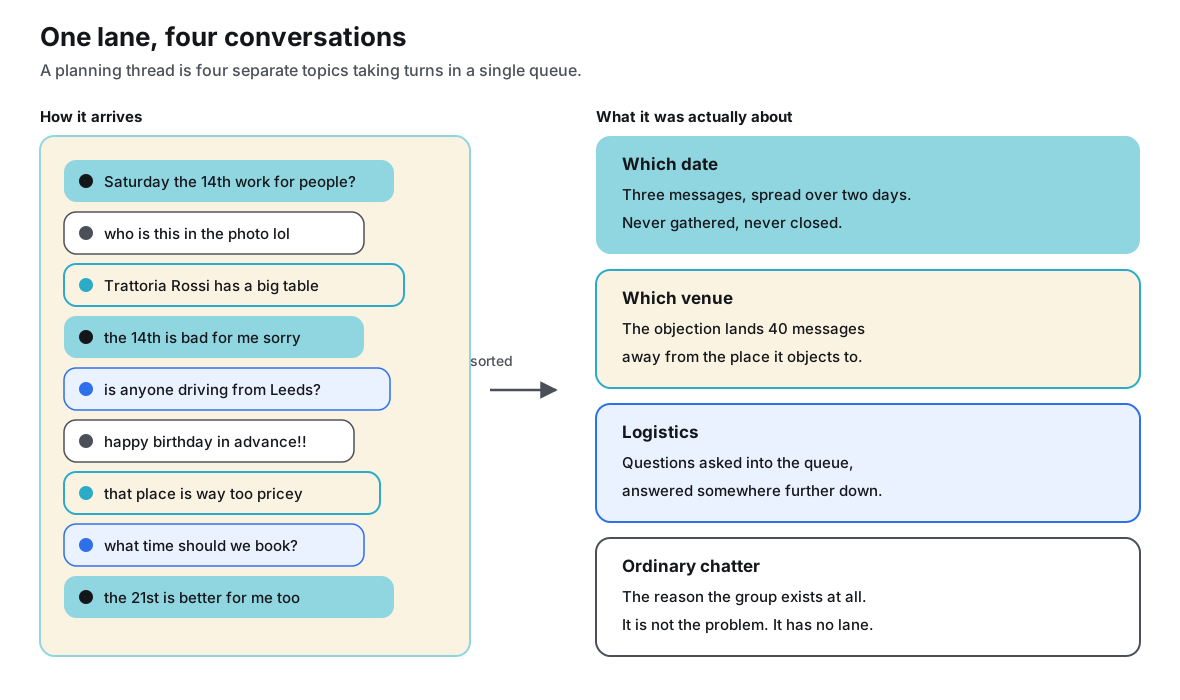
The visible cost is that objections drift away from their targets. Somebody proposes a restaurant, forty messages of birthday nostalgia go past, and then somebody writes "honestly that place is way too pricey".
Too pricey for what? Half the group has to scroll back to find out, and half the group will not bother.
Replies help with this, and they are the best feature in the app for planning. Quote a message and the connection is visible again.
The limit is that a reply is a one-hop link, not a thread. Three replies deep into a venue debate, you have a chain nobody can see as a chain. WhatsApp is not trying to be a forum, and it should not be.
Mechanism four: a reply is an ambiguous signal
Here is where the organiser quietly starts suffering.
Ask twenty-three people whether they are coming and you will get a beautiful variety of human responses. What you will not get is a list.
| What arrives | What they meant | What it proves |
|---|---|---|
| Thumbs-up reaction | Anything from "I'm in" to "seen, acknowledged" | That they opened the app |
| "Yes!!" | Usually genuinely yes | Nothing that survives a date change |
| "I'll try to make it" | Roughly a coin flip | That they are polite |
| "Count me in but I'll be late" | Coming, plus a logistics fact | Two things at once, in one place, forever |
| A private message to the organiser | Coming, quietly | Something only one person knows |
| A poll vote for that Saturday | The date works for them | Availability, which is not attendance |
| Silence | Unknowable | Nothing at all, and there are nine of these |
Every one of those is a perfectly reasonable human reply. None of them is an answer a system could count.
The silence row is the interesting one. In a thread, the person who has not replied is indistinguishable from the person who is coming, the person who is not, and the person who muted the group in March.
Proper event formats solved this decades ago by giving silence a name. In the IETF specification behind every calendar invite, each attendee carries a participation status, and its default value is NEEDS-ACTION. Not silence, not absence: an explicit state meaning "this person has been asked and has not answered".
That single default is the difference between a headcount and a guess. It is also why counting attendance from a conversation stays hard no matter how carefully you read.
Mechanism five: every update is charged to the whole group
Changing a fact in a record costs one edit. Changing a fact in a chat costs twenty-three interruptions.
That price is real, and organisers feel it. It is why updates get delayed, softened, and bundled together into one big message on Thursday night.
Watch the language it produces. "Sorry to spam everyone, but just to confirm" is a person apologising for doing the job correctly.
The consequences are not subtle. The venue change waits until there is enough news to justify a notification. Two people book trains in the meantime.
WhatsApp has tools here and they are decent ones. You can mention specific members with @, or use @all to reach everybody when something genuinely matters.
Mentions work because they are rationed. Use @all for every venue tweak and the group will start treating @all the way it treats a car alarm.
Then there is mute, which is the group's immune response. Muting is a sensible thing to do to a lively group, and it silently converts that person into someone who will find out about the time change at some unpredictable later point.
Nobody is at fault in that sentence either. Managing a plan that keeps changing inside a message thread means every correction has to buy attention it cannot afford.
Mechanism six: size multiplies everything above
All five mechanisms exist in a group of six. You just do not notice, because six people can hold the plan in their heads.
Scale is where it stops being funny. A WhatsApp group can hold up to 1,024 members, which is a wonderful number for a neighbourhood and an absurd one for a dinner.
The interesting part is that WhatsApp's own settings agree with this. Groups behave differently at different sizes, and the thresholds are visible in the product.
| Group size | What WhatsApp does | What it feels like to plan in |
|---|---|---|
| Under 33 | Members can add others and share a group invite link by default | Fluid and friendly, everyone can see everyone |
| Roughly 30 to 100 | Nothing special changes | The first thread where scrolling back stops being viable |
| Over 256 | Edit group settings defaults to admins only | The group has become a broadcast with a comments section |
| Up to 1,024 | The hard ceiling on members | Every message is a notification for a thousand phones |
Read that table as a design confession. WhatsApp knows that above a certain size a group stops being a conversation, so it starts handing controls to admins.
What it cannot hand over is the record, because there is no record to hand over. Admin powers control who may speak, not what is true.
Size also breaks the one workaround everybody relies on, which is asking. In a group of nine, "what time again?" is a friendly nudge. In a group of two hundred, it is a notification sent to two hundred people, so people stop asking and start guessing.
There is a privacy dimension too, and it surprises people. Everyone in that group can see everyone else's number, which is a lot of exposure for a dinner, and it is why large WhatsApp groups quietly become a privacy question.
What groups try, and how far each thing gets
Nobody suffers this passively. Every group that has been burned once invents a fix, and the fixes are genuinely clever.
They also all half-work, and they half-work in interestingly different ways.
| The fix | What it genuinely solves | Where it runs out |
|---|---|---|
| Pin the details | Ranking: the facts stop sinking | It cannot update itself, and it expires |
| Run a poll | Decisions: closes one question cleanly | Measures availability, not attendance |
| Re-post a recap | Recency: puts the truth back on top | Creates a second copy that can drift |
| Start an announcements group | Lanes: separates signal from chatter | Splits the group into two places to check |
| Create a WhatsApp Event | Answers: gives you Going, Maybe, Not going | Lives inside one chat and cannot leave it |
Pinning: right instinct, wrong physics
Pinning is the correct first move and I will defend it against anyone. It is the only feature in the app that fights the recency ranking directly.
WhatsApp lets you pin up to four messages, with a duration of 24 hours, 7 days or 30 days. The pinned message shows as a banner at the top of the chat, and if the duration runs out it unpins itself.
Read that again, because two details in it decide the outcome.
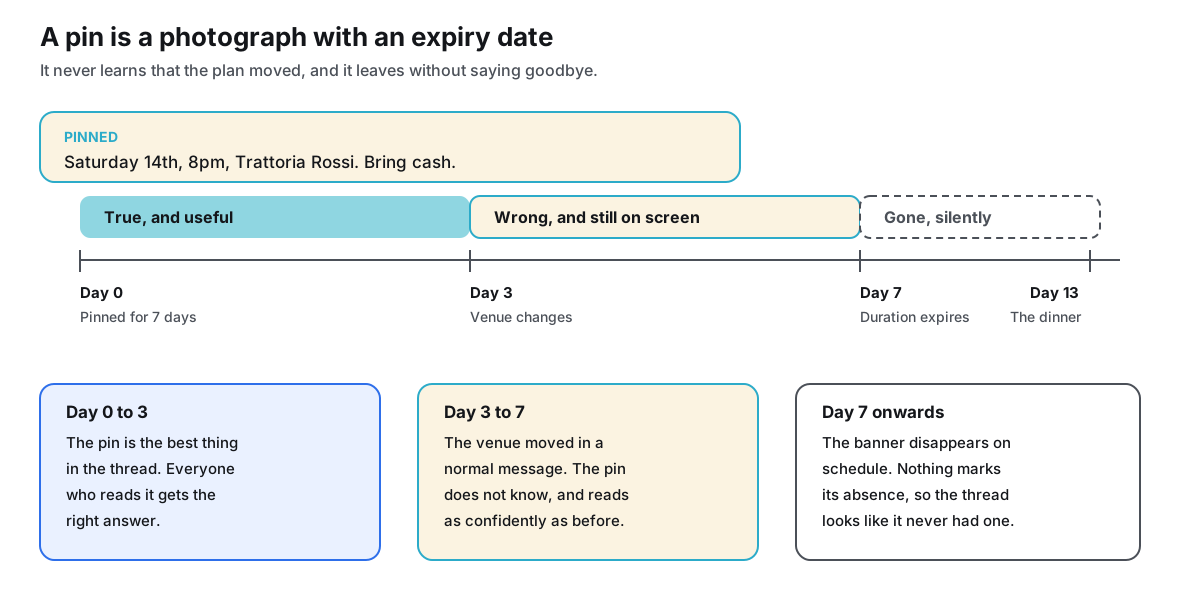
The first detail is that a pin points at a message, and a message cannot change its mind. When the venue moves, the pin keeps displaying the old venue with total confidence until a human notices and swaps it.
That is worse than having no pin. Someone who reads a stale pin now holds wrong information and has no reason to doubt it.
The second detail is the expiry. Pick 7 days on a plan that is three weeks out and the banner vanishes at exactly the moment people start double-checking.
The four-pin allowance also invites a trap. Pin the venue, the time, the map and the payment details, and you now have four banners that have to be kept in sync by hand, which is a job.
Polls: excellent at closing, useless at holding
Polls are the best decision tool in the app. You can offer up to 12 options, with multiple answers allowed by default, and get a live count without anybody having to tally replies.
For "which of these three Saturdays" that is close to perfect. Use it.
Two things go wrong afterwards, and both are category errors rather than bugs.
The first is that voting a date works is a statement about your calendar. Saying you are coming is a promise, and those are different sentences that the poll UI makes look identical.
The second is that votes can be changed or removed at any time, which is correct behaviour for a poll and disastrous behaviour for a headcount. Your final number is whatever it happened to be the last time you looked at it.
Then the poll scrolls away like everything else. This is the whole reason a chat poll and an event RSVP are not the same instrument, even when they produce the same number on a Tuesday.
The re-posted recap: a heroic act with a flaw
At some point one person reads the entire thread and posts a tidy summary. This person is doing unpaid database work and deserves a drink.
It works immediately and it works completely, for about a day.
The flaw is that the recap is a copy. The moment anything changes, there are two versions of the truth in the same thread, and the older one is more likely to be found because more people have already scrolled past it.
Two messages saying "FINAL" in one thread is the clearest diagnostic in group planning. It means somebody is faking state with repetition, and repetition is the one thing a chat is guaranteed to keep.
The second group: a real fix with a real cost
Eventually somebody starts "Priya 40 INFO ONLY" and sets it so that only admins can post. This is not silly, and WhatsApp explicitly supports it: group permissions let you turn off Send new messages so only admins can post.
It genuinely fixes the lane problem. Announcements stop competing with jokes, and that is a real improvement.
The cost is that the group now has two places to check, and human beings do not reliably check two places. It also does nothing about state, because an announcements group is still a history, only a tidier one.
And every new person now has to be added twice. Which is precisely the pain described in the awkwardness of adding one more person to a group chat, doubled.
WhatsApp Events: the closest thing to an actual answer
WhatsApp has shipped something genuinely aimed at this, and it deserves proper credit. You can create an event inside a chat with a name, date, time, location and description, and people respond Going, Maybe or Not going.
That is a real record with real answers. It fixes the ambiguous-reply problem inside that one chat, and if your whole group lives in one WhatsApp group you should absolutely use it.
Its boundaries are documented and they are worth knowing before you rely on it.
- An event can only be hosted by one person. There is no co-host, so if the organiser goes on holiday the event cannot be edited.
- You cannot invite anyone who is not already in that chat, and you cannot forward the event to another chat.
- New members cannot see events created before they joined. To include them, the documentation says to delete the old event and create a new one.
That third one is the sharpest. A plan that is invisible to everyone who arrived late is a plan with a hole in exactly the place late joiners stand.
None of this makes the feature bad. It makes it a chat feature, scoped to a chat, which is a completely honest thing for WhatsApp to build.
Rescuing a thread that is already a disaster
Sometimes it is Tuesday, the thread has 340 messages, and the thing is on Saturday. Diagnosis can wait.
Here is a repair that works. It is a person doing a database's job by hand, which is fine for one event and grim as a lifestyle.
- Read the whole thread once, from the top, privately. Not skim, read. Do it in one sitting so you are comparing messages against each other rather than against your memory.
- Write down the six facts, and nothing else. Final date, final time, exact address, who is coming, what to bring, what changed since the first plan. If you cannot fill one in, that is your most urgent problem, not a gap to paper over.
- Resolve the contradictions before you post anything. Where two messages disagree, ask the one person who can settle it, in a direct message. Settling it in the group starts the debate again with a fresh audience.
- Post one message, formatted so it can be read at a glance. One line per fact, no preamble, no apology for the length. Nobody has ever been annoyed by a message that answered their question.
- Pin exactly one thing, and pick a duration that outlives the event. One pin, not four. If the plan is more than a week out, choose 30 days rather than 7 so the banner does not vanish during the anxious final week.
- Answer every later question by pointing, not retelling. "It's in the pin" feels curt for about a day and then feels like relief. Every restatement you type is a new copy that can drift out of date.
- When something changes, replace the pin instead of adding to it. The moment two pinned versions coexist, you have rebuilt the original problem one floor up. Edit or unpin, then pin the new one.
- Afterwards, decide whether the group should do this again. If you have run this rescue twice for the same group, the thread is not the problem you keep having. The absence of somewhere to put facts is.
Two hours of your life, and it holds. It holds because you have manually imitated the thing the chat does not have, which is a single source of truth for the event.
How to tell your group has crossed the line
Size predicts this badly. A quiet group of forty is fine, and a lively group of eight can bury a venue change before lunch.
These are the signals that actually mean something.
- The same question comes back a third time. That is not forgetfulness, it is the absence of anywhere to look.
- The real headcount lives in one person's notes app. A human has become the database, and the database is going out on Friday.
- Somebody says "just to confirm" about a thing that was confirmed twice already.
- A late joiner cannot catch up by reading. The information is present but not reachable, which is a different failure.
- Someone turns up wrong. Wrong time, wrong place, wrong week, and the other four signals were predicting it.
Two of those and etiquette will not save you. Better manners raise the ceiling; only structure removes it.
Where Ontaym fits
This is the one section that is about us, and then we are done.
Ontaym holds the part your group chat cannot: one event, at one address, with the current time, the current place and each person's actual answer. It is a record rather than a transcript, so changing it changes it everywhere rather than adding a message.
The group chat stays exactly where it is. You drop a link into it, and the link keeps being right, including for the people who join in week three.
Guests answer without joining anything and without their phone number being handed to twenty-two strangers. That matters more than it sounds when the group is a mix of close friends and someone's new partner.
If you have already had the argument about whether to move an event out of WhatsApp and onto its own page, that is the shape of the answer. The conversation does not move. Only the facts do.
What to actually take from this
The useful shift is to stop asking your group to be more organised. They are already trying, and trying is not the constraint.
Ask instead which of the two jobs is hurting. If the hard part is deciding, arguing, persuading or getting people excited, that is conversation, and WhatsApp is already the best tool you have. Leave it completely alone.
If the hard part is that nobody can find the time, or the headcount lives in one person's head, that is state. No amount of better messaging produces state, because appending is not updating.
Then the fix is small and slightly boring. Give the plan one address, put the current facts there, and let the thread point at it instead of retelling it.
The group does not go quiet afterwards, which surprises people every time. It just stops doing admin, and goes back to being the reason you all know each other.
Frequently asked questions
Why do WhatsApp groups get so messy when planning an event?
Because a thread appends rather than updates. When the time or venue changes, the old version stays in the group looking exactly as authoritative as the new one, and the only thing separating them is scroll position. Add recency-only ordering, four topics sharing one lane and twenty-odd people replying in their own way, and the mess assembles itself without anybody being careless.
Is pinning a message enough to fix it?
It is the best move available inside WhatsApp and it still falls short. A pin points at a message, so when the plan changes the banner keeps showing the old details confidently until a human swaps it, and pins carry a duration of 24 hours, 7 days or 30 days after which they unpin themselves. Pick a duration that outlives the event, and keep it to one pin rather than four.
Do WhatsApp polls work for headcounts?
They work brilliantly for closing one question, such as which of three Saturdays suits people. They are weak as a headcount because voting that a date works is a statement about your calendar rather than a promise to attend, and votes can be changed or removed at any time. Your number is only ever accurate at the moment you look at it.
What about WhatsApp's built-in events feature?
It is a genuine improvement and worth using if your whole group lives in one chat, since guests answer Going, Maybe or Not going. Its documented limits matter though: an event has a single host with no co-host, it cannot be forwarded to another chat or shared with anyone outside it, and new members cannot see events created before they joined. Anyone who arrives late simply does not see the plan.
How many people can a WhatsApp group hold, and does size matter?
A group can hold up to 1,024 members, and the app changes its own behaviour as groups grow, defaulting group settings to admins only above 256 members. For planning, activity matters more than headcount: a quiet group of forty copes fine while a lively group of eight can bury a venue change in an afternoon. Size mostly multiplies problems that were already there.
Should we start a separate announcements group?
It genuinely fixes one thing, because WhatsApp lets admins turn off Send new messages so only admins can post, which stops announcements competing with jokes. The cost is that your group now has two places to check and everyone must be added to both. It also does nothing about state, since an announcements group is still a history, just a tidier one.
Is this a WhatsApp problem or a group chat problem?
It is a group chat problem, and WhatsApp is one of the better chat apps to have it in. Any tool built to carry an ordered stream of talk will struggle to carry a record that needs updating, because appending and updating are different operations. The same failure shows up in iMessage, Telegram, Signal and Discord threads.
What is the fastest way to rescue a thread that is already chaotic?
Read it end to end once, privately, and write down six facts: final date, final time, exact address, who is coming, what to bring and what has changed. Settle any contradictions by direct message rather than reopening the debate in the group, then post one clearly formatted message and pin it with a duration that outlasts the event. From then on answer questions by pointing at the pin instead of retyping the details.
Give your next plan one address instead of one more thread.
Plan it with Ontaym