
Why WeChat Group Chats Become Difficult for Event Coordination
WeChat is the strongest counterexample to the idea that chat apps cannot hold a plan. It runs applications inside the conversation, takes payments and even lets a shared card know which group it landed in. Your dinner for nine is still a wall of text anyway, and the reason is more interesting than bad design.

Quick answer
WeChat group chats are excellent at deciding things and poor at remembering them, because a thread stores history while a plan needs state. Move the dinner from seven to eight and both times stay visible, with the truth living only in their order.
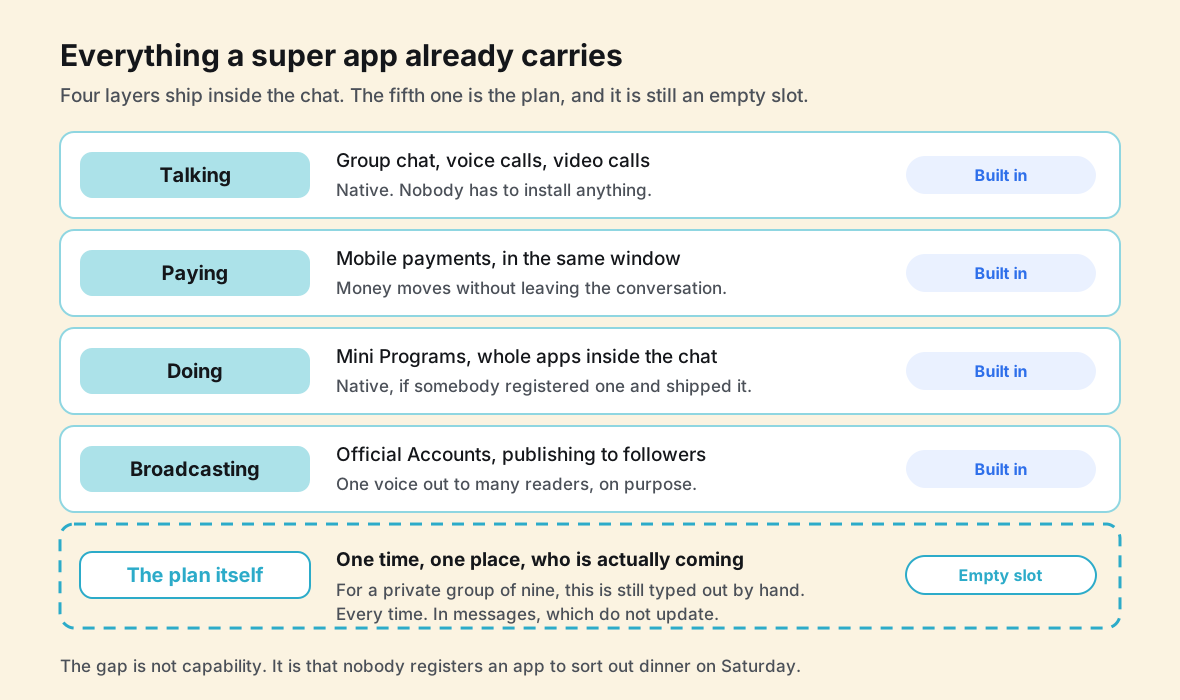
What makes WeChat unusual is that the platform could plausibly hold the record natively. Mini Programs run inside the chat, a forwarded card can be told which group it is in, and payments already work in the same window.
That capability reaches developers, not friends. Building it needs a registered account, an AppID and a reviewed release, so businesses get structured tools and private groups get messages.
Nine people, one restaurant, one very long thread
Somebody suggests dinner on Saturday. Nine people say yes in a group chat, and one of them sends a photo of a menu.
By Thursday the time has moved once, the place has moved once, and the person who muted the group on Tuesday still thinks it is at seven.
Every messaging app on earth produces this story. What makes WeChat interesting is that it is the one place where it arguably should not happen.
Because WeChat is not really a messaging app. It is a chat window with an entire software platform living inside it.
Its own site describes the product as free chat, HD voice and video calls, Moments, mobile payments and Mini Programs, all in the same app. You can pay a friend, order food, hail a car and buy a train ticket without ever leaving the conversation.
So here is the honest question this article is about. If a platform can run whole applications inside a chat, why is your dinner for nine still being reconstructed from messages?
Start with what the group chat gets right
It would be lazy to open by calling WeChat groups bad at coordination. They are extremely good at most of it.
A group chat is where a plan is born, and birth is a conversational act. Somebody floats an idea, three people react, one person says the place near the station is better, and the shape of the evening appears out of nothing.
No structured tool does that. Give a group an empty form with a date field and the idea dies on contact.
Chat is also where enthusiasm lives. The photo of last time, the running joke about who was late, the small negotiation about whether to invite the cousin. That is not overhead, it is the reason the group exists at all.
Then there is reach. Everyone is already in there, nobody needs installing, and a message arrives on a phone that is already unlocked in someone's hand.
A group chat is the best place in the world to decide something and the worst place to remember it.
The failure is narrow and specific. It is not that chat is disorganised, it is that a thread stores history when what a plan needs is state.
History is every sentence anyone said, kept in order, forever. State is the short list of things that are true right now.
When the dinner moves from seven to eight, a thread does not change its mind. It keeps both times, both equally visible, and leaves the reader to work out which one won. We took that distinction apart properly in a separate piece on what separates a conversation from an event object, and it is the engine underneath everything below.
Why a big group stops behaving like a small one
WeChat groups scale further than most people's social lives do. A class, a residents' association, a hobby club and an entire extended family can all sit in one chat comfortably.
That is a real strength, and it is also where coordination changes character. A group of nine and a group of several hundred are not the same object with a different number attached.
Three things flip as a group grows.
Reading stops being universal. In a small group everyone reads everything, so a single announcement is genuinely received. In a large one, most members skim, many mute, and an announcement becomes something you broadcast and hope about.
Silence stops meaning anything. In nine people, the two who have not answered are noticeable. In three hundred, silence is the default state and carries no information at all.
Volume outruns memory. A busy group can bury an address under a hundred unrelated messages in an afternoon, which is exactly the mechanism behind the moment a WeChat group gets too large to plan in.
Note that none of those are about the member limit. Whatever number your group is capped at matters far less than how many people actually read it.
Activity is the real variable. A quiet group of two hundred plans a picnic fine, and a lively group of twelve can lose a venue change before lunch.
| The job | In a group of nine | In a group of several hundred |
|---|---|---|
| Announcing the time | One message, read by everyone within the hour | One message, read by an unknown fraction, ever |
| Getting a headcount | Count the replies, chase the two who went quiet | Impossible by hand, so nobody tries |
| Interpreting silence | Meaningful, and usually worth a nudge | Meaningless, because most members always go quiet |
| Changing the venue | Mildly annoying, everyone finds out | Genuinely risky, because the old venue stays legible |
| Handling a late joiner | Someone retells the plan in two lines | Nobody notices they joined, let alone briefs them |
| Cost of one more message | Near zero, the group is already chatty | High, because it interrupts hundreds of people at once |
That last row is the cruel one. In a large group, the polite organiser sends fewer updates, and the plan most in need of updates gets the fewest.
So the mess is not carelessness. It is a rational response to a medium where correcting yourself costs everybody's attention.
The part that makes WeChat different
Now to the interesting bit. Every other chat app can shrug and say coordination is somebody else's layer, because it has no somebody else inside it.
WeChat cannot say that. It already runs applications in the chat window, takes payments, and lets a small program appear when someone taps a card in a conversation.
Tencent's own developer documentation describes Mini Programs as a way to build services with native app experiences inside Weixin, with login, payments, sharing and cloud storage available to the developer.
So the raw capability for a proper event record is sitting right there. Something that holds one time, one place, one guest list and each person's answer is, technically, a very small application.
The group-aware bit actually exists
Here is the detail that surprised me most while reading the documentation. A Mini Program shared into a group chat can be told which group it is in.
The mechanism is called a share ticket. A developer turns on the option when showing the share menu, and when someone in the group opens the forwarded card, the program receives a ticket identifying the group it was forwarded to.
The documentation is explicit that this only comes back for group forwards, not for one-to-one shares. It exists precisely so that a shared thing can behave like a shared thing.
Read that as a coordination primitive and it is remarkable. It means the platform has a native concept of a group-scoped object that several people in one chat are looking at together.
There is a notification path too. A Mini Program can send subscribe messages, and the documentation describes the user granting that permission through a prompt, with an option to keep the choice rather than be asked repeatedly.
Consent for updates, a group identity, payments, and a card that opens in the conversation without an install. On paper that is most of an event platform.
So why is your dinner still a wall of text?
Because all of that is developer capability, and a dinner for nine has no developer.
Every piece of it starts from a registered Mini Program account with an AppID, which Tencent's quick start describes as an identity for the Mini Program platform that you then use everywhere else. That is a completely reasonable requirement for a business and an absurd one for a birthday.
Then someone has to write it, submit a version, and get it released. Saturday does not wait for a release cycle.
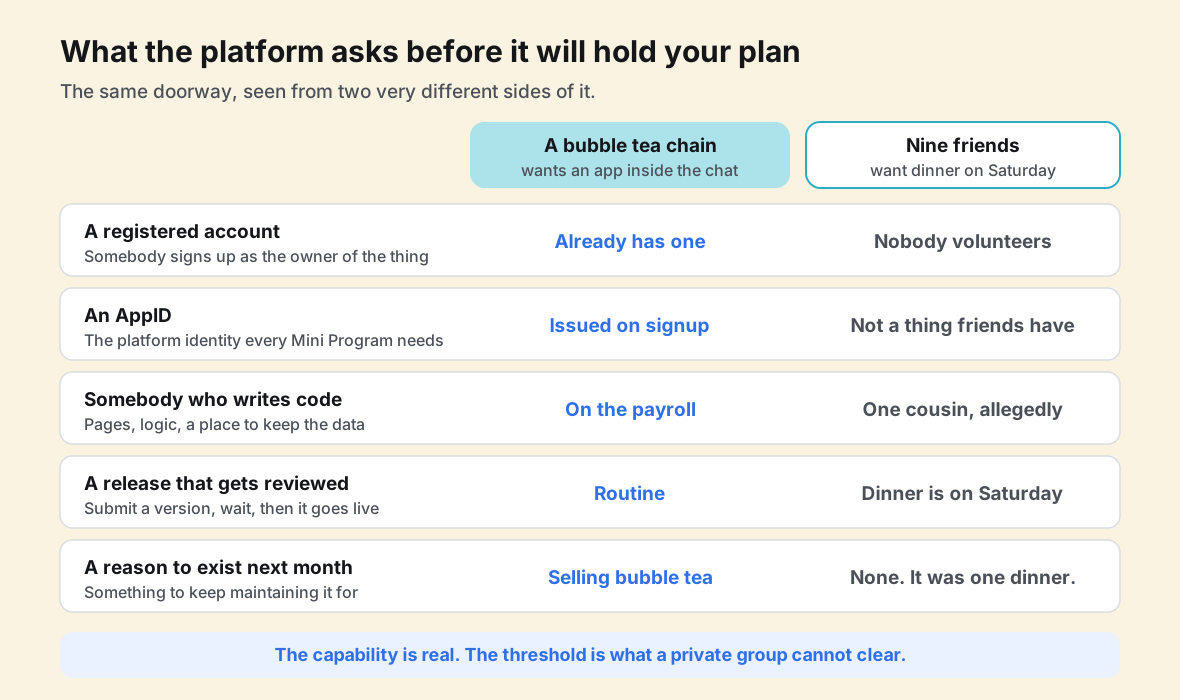
This is the honest shape of the WeChat gap. The platform did not fail to build the coordination layer, it built the tools to build one and then handed them to whoever has a company.
Which is why the Mini Programs you meet in real life are restaurants, retailers, transport and utilities. Ordinary private groups do not appear in that list, because there is no ordinary private group with a release process.
What a super app genuinely solves
It would be unfair to stop there, because the super app model does solve real coordination problems that other chat apps leave open.
Payment is the clearest one. Splitting a bill is normally a second app, a bank transfer and three reminders, and inside WeChat it is a thing that happens in the same window as the argument about who ordered the extra dish.
Booking is another. If the restaurant has a Mini Program, the person organising can hold a table without ever leaving the chat, and that removes a genuine step from the evening.
Identity is quietly solved too. You do not need somebody's phone number to include them, which is a real privacy advantage over apps where a phone number is the only handle anyone has.
So the super app collapses several separate errands into one surface. That is a serious achievement and it is why the model gets copied.
What it does not do is change the nature of a message. A payment record is structured, a booking is structured, and the plan connecting them is still prose in a scrolling list.
| Part of the evening | Inside the chat | Still unsolved |
|---|---|---|
| Deciding to go | Conversation, which chat does better than anything | Nothing. This part works. |
| Paying and splitting | Handled natively, in the same window | Nothing, as long as everyone pays |
| Booking the venue | A Mini Program, if the venue has one | The booking knows the venue, not your guest list |
| The current time and place | A message, somewhere above | Nothing marks the old time as dead |
| Who is actually coming | Replies, reactions, private messages, silence | No list exists. One person keeps it in their head. |
| What changed since Monday | Scattered across the thread in order | No revision, no timestamp, no summary |
| Briefing a late joiner | Somebody retypes the plan | Retyping makes a second copy that can drift |
Look down the unsolved column and a pattern shows up. Everything with a commercial counterparty got structured, and everything purely social stayed as text.
That is not a conspiracy, it is where the incentive was. A restaurant will build the booking flow because the restaurant gets paid, and nobody gets paid when nine friends work out a Saturday.
The bit a message can never do
Strip the platform question away and one stubborn fact remains. A message can contain a fact but it cannot hold one.
Send "let's make it eight" and you have created a permanent record that someone once proposed eight. You have not changed anything, because there was nothing there to change.
The truth now lives in the ordering of two messages, and ordering is a terrible place to keep truth. Two careful people can read the same thread and arrive an hour apart without either of them misreading a word.
This is not a new observation and it is not WeChat's fault. The alternative was specified by the IETF in 2009, in RFC 5545, the standard behind every calendar file you have ever opened.
What it defines is an event as a set of named fields rather than a description of one. Read the field names and you can hear a group chat failing.
| Field | What it holds | What the thread does instead |
|---|---|---|
UID | One permanent address for this event | Retells the plan each time somebody asks |
DTSTART | One start time, with a time zone | Keeps three candidate times, all still visible |
LOCATION | One current place | Stores a screenshot of a map from last month |
ORGANIZER | Whose version is authoritative | Lets the most recent confident message win |
ATTENDEE with PARTSTAT | Each person, and their answer | Makes one human count reactions by hand |
SEQUENCE | Which revision this is | Gives no way to tell whose copy is older |
STATUS | Confirmed, tentative or cancelled | Leaves "probably still on" as a tone of voice |
LAST-MODIFIED | When this last changed | Hides staleness until somebody asks again |
The one worth staring at is PARTSTAT, the per-person answer, whose default value in the standard is NEEDS-ACTION. That single default gives silence a name.
In any group chat, the person who has not replied looks exactly like the person who is coming, the person who is not, and the person who last opened the app on Tuesday. A record can tell those four apart, and no amount of scrolling can.
There is a companion standard, RFC 5546, which defines how invitations and replies travel. So the record, the invitation and the response were all formally specified well over a decade ago.
The workarounds people actually use
Nobody waits for a platform to fix this. Groups invent their own machinery, and it is worth being fair about how well it works.
The pinned or announced message. This is the single best move available inside a chat and you should absolutely do it. Its limit is that it is a photograph rather than a record, so when the plan changes it is either stale or swapped, and whoever read version one now holds old facts confidently.
The poll. Excellent at closing one question at one moment, and quietly misleading afterwards. Voting that Saturday works is a statement about your calendar, while saying you are coming is a promise, which is the confusion pulled apart in the piece on what a WeChat poll can and cannot decide.
The organiser's private list. Someone opens a notes app and keeps the real headcount there. This works beautifully and it means a human being has become the database, which is fine for one dinner and grim as a habit.
The second group chat. A smaller group is created for the people who are definitely coming. It solves the noise problem and creates two sources of truth, which is strictly worse than one, and it is why adding one more person to a group chat is never as small a move as it looks.
The screenshot. Somebody screenshots the confirmed details and sends it to the group. It cannot be edited, cannot be searched, and will be forwarded to a friend three weeks after it stopped being true.
Every one of these is a person imitating a database with the tools available. They work, and they leave nothing behind for the next event, which is why a group that meets regularly rebuilds the same scaffolding every single time.
How to tell your group has outgrown the thread
Size is a bad signal, as established. Watch for behaviour instead.
- The same question returns a third time. "What time again?" is not forgetfulness. It means there is nowhere to look, so asking a human is genuinely the fastest route.
- One person is keeping a private list. If the real headcount lives in somebody's notes app, the group has appointed a database without telling them.
- Two messages both say final. Two finals in one thread is the clearest sign that state is being faked with repetition.
- A late joiner needs a briefing. If somebody who joins on day ten cannot catch up by reading, the information is present but not reachable, which is not the same thing.
- Somebody turns up wrong. Wrong time, wrong place, wrong week. This is the outcome the previous four were quietly predicting.
Two of those in one plan and etiquette has stopped helping. Better manners raise the ceiling, and structure removes it.
The repair that works without leaving WeChat
Suppose the thread is already a mess and the event is on Thursday. There is a field repair, and it works by imitating the missing record as cheaply as possible.
Read the thread once, end to end, and write down what is currently true. Do it properly and do it privately, so that nobody else has to.
Post that as one clearly formatted message, and make it the group's announcement if the group has one. One anchor, not four.
Then answer every subsequent question with a pointer rather than a restatement. This feels curt for roughly a day and then it feels like relief.
When something changes, replace the anchor instead of adding a new message beside it. The moment two anchors coexist you have rebuilt the original problem one floor up.
This genuinely works for one event. It is also a person doing a database's job by hand, and it evaporates the moment they get busy.
What the missing layer would have to look like
Put the constraints side by side and the shape describes itself. It is narrower than either neighbour.
It has to hold a real record, with the fields the standard named. Without those it is just another message with better manners.
It has to be private by default, because for a dinner the guest list is the entire audience. Discovery is not a feature here, it is a hazard.
It has to cost the guest nothing. If answering needs an account, an install or a registration, a solid chunk of any real group will not answer and you are back to counting reactions by hand.
And it has to leave the conversation completely alone. That last one is the requirement everyone skips, and it is the one that makes the rest work.
Notice that this is not a request for WeChat to change. It is a description of a thing that can sit outside any chat app and be pointed at from inside it, which is the argument made at more length about whether super apps are where event coordination ends up.
The move is a pointer, not a migration
Nobody is going to move their family group off WeChat, and they should not. The group is where the group is, and that is the correct place for it.
What changes is where the facts live. The plan gets one address, and every thread links to that address instead of repeating what it says.
This sounds too simple to be the answer. It works because it stops asking one tool to do two jobs.
Repeat a fact in a thread and you have made a second copy that can drift. Point at the record and there is nothing to drift from.
It also handles the case nothing else handles. When half your group is on WeChat and the cousin who moved abroad is not, a link opens for both, which is the practical version of coordinating a group that is split across different messaging apps.
Where Ontaym fits
Ontaym builds that middle layer, which is the honest reason this article exists.
An event is a record rather than a transcript. It has one address you can drop into a WeChat group, or any other conversation, and it stays correct when the time moves.
Guests answer without swapping contact details with everyone else on the list. Your chat stays exactly where it is, doing the part it is genuinely good at.
That is a deliberately small scope. A ticketed conference belongs somewhere built for publication, and coffee with one friend needs nothing at all.
What to take from this
WeChat is the most interesting case in this whole argument because it comes closest to disproving it. The capability really is in the building, and the group identity really does exist in the API.
The gap survives anyway, and for a reason that has nothing to do with engineering. Platform capability arrives through developers, and private groups do not have any.
So when planning feels harder than the event deserves, stop asking which app is best. Ask which layer is being made to do another layer's job.
If the hard part is deciding, arguing or getting people excited, that is conversation, and your group chat is already the right tool. Leave it completely alone.
If the hard part is that nobody can find the time, or the headcount lives in one person's head, that is state. No amount of better messaging will produce it, which is the same conclusion reached from the other direction in the piece on why WeChat conversation and WeChat event information keep getting confused.
Give the plan one address, keep the current facts there, and let the group carry on talking. The chat does not go quiet afterwards, which surprises people. It just stops doing admin.
Frequently asked questions
Why is a WeChat group chat hard to coordinate an event in?
Because a thread adds messages rather than updating facts. When the time or venue changes, the old version stays in the conversation looking exactly as real as the new one, and the truth lives only in the order of two messages. Nothing on screen marks the earlier plan as dead, so every reader has to reconstruct the present from the history.
WeChat has Mini Programs, so why is there no built-in event tool for my friends?
The capability is genuinely there, but it is developer capability. Building a Mini Program starts with a registered account and an AppID, then code and a reviewed release, which is a reasonable ask for a shop and an unreasonable one for a dinner. So the structured tools inside WeChat belong to businesses, and private groups are left with prose.
Can a Mini Program tell which group chat it was shared into?
Yes, through a share ticket. Tencent's developer documentation describes enabling it on the share menu so that when a forwarded Mini Program is opened, the program receives a ticket identifying the group. It only comes back for group forwards, not for one-to-one shares, which makes it a genuinely group-aware mechanism.
Does group size affect how badly this goes?
Activity matters more than size. A quiet group of two hundred can plan a picnic without trouble, while a lively group of twelve can bury a venue change in an afternoon. What does change with size is that silence stops carrying information and updates start costing hundreds of people an interruption.
Is pinning or announcing the details enough?
It is the best move available inside a chat and worth doing every time. Its limit is that it is a photograph of one moment rather than a live record, so when the plan changes it is either stale or manually swapped. It also cannot say who is coming, what changed, or how old it is.
Has anyone standardised what an event record should contain?
Yes, and long before most group chats existed. RFC 5545, published by the IETF in 2009, defines the event object behind calendar files, including one start time, one location, an organiser, each attendee's answer, a revision number and a last-modified timestamp. RFC 5546 defines how the invitation and the reply travel between people.
Does fixing this mean moving my group off WeChat?
No, and that would be the wrong move. The group keeps talking exactly where it already talks, and the plan gets one address that every thread points at instead of retelling. That also solves mixed groups, because a link opens for the people who are not on WeChat at all.
What does a super app actually solve for coordination?
Quite a lot, and it is worth crediting. Payment, splitting a bill, booking a venue that has its own Mini Program and including someone without knowing their phone number all happen inside the conversation. What it does not change is the nature of a message, so the plan connecting those errands is still text in a scrolling list.
Give your next plan one address instead of one more thread.
Plan it with Ontaym