
Why Not Everyone Wants to Join Another Group Chat
Nobody flinches at the dinner. They flinch at the words before it: I'll add you to the group. Here is what that request is actually asking for, why leaving costs more than joining, and why a plan should never require joining anything at all.

Quick answer
An invitation asks for one evening. Being added to a group chat asks for an open-ended membership with no end date, no agenda and no quiet way out.
Joining takes one tap and is barely noticed. Leaving posts a line in the thread with your name on it, which people read as a statement about them, so most people mute instead and stop reading.
Membership also exposes your number, your profile and your read state to everyone else on the list. None of that is needed to answer a question about a Saturday, which is why the plan should live at one link rather than inside a room.
The five words that make a friendly person tense
"I'll add you to the group." Said warmly, meant kindly, and received by a surprising number of people with a small internal flinch.
Not because they dislike anyone in it. Not because they are antisocial, or precious about their time, or too good for a bit of chatter on a Tuesday.
It is because they have done this before. They know what the next six weeks look like, and they know how hard it will be to get out afterwards.
This article is not a complaint about group chats. Group chats are one of the best things phones ever produced, and most of the good bits of modern friendship happen inside them.
It is about a narrower thing. When the only way to be included in a plan is to join a permanent room full of people, some perfectly sociable people will quietly decline, and the plan loses them.
That is worth understanding properly, because organisers almost never intend it. Nobody adding you to a chat thinks of themselves as asking for anything.
A group chat is a commitment, not a message
Here is the mismatch at the centre of everything else. Being invited to an event is a bounded request, and being added to a group chat is an open-ended one.
An invitation asks for one evening. You answer, the evening happens, the thing is finished and everyone goes back to their lives.
A group is different in kind. It has no end date, no agenda, no fixed size, and no natural moment where it stops.
You are not agreeing to Saturday. You are agreeing to whatever this room decides to become, indefinitely.
Nobody minds the dinner. What they mind is signing up to an unbounded thing in order to attend a bounded one.
Most of the time it becomes something pleasant. Sometimes it becomes a photo dump, a running argument about football, or the place a family relitigates Christmas.
The point is that you cannot tell at the moment you are added. You are asked to accept a permanent commitment on the basis of a single Saturday.
Leaving is a visible act, and everybody knows it
This is the part that makes the whole thing sticky. In almost every messaging app, going in is silent and going out is announced.
Leaving is mechanically trivial. On every major messenger it is two taps and a confirmation, and the mechanics were never the problem.
The problem is that your departure lands in the thread as a line of text with your name in it. Everyone who scrolls past it reads it, and reading it takes about a second.
In that second, people fill in a reason: bored of us, annoyed about something, too busy for this lot. Almost none of those will be true.
It rarely matters. You are not there to explain, and explaining afterwards is worse than leaving.
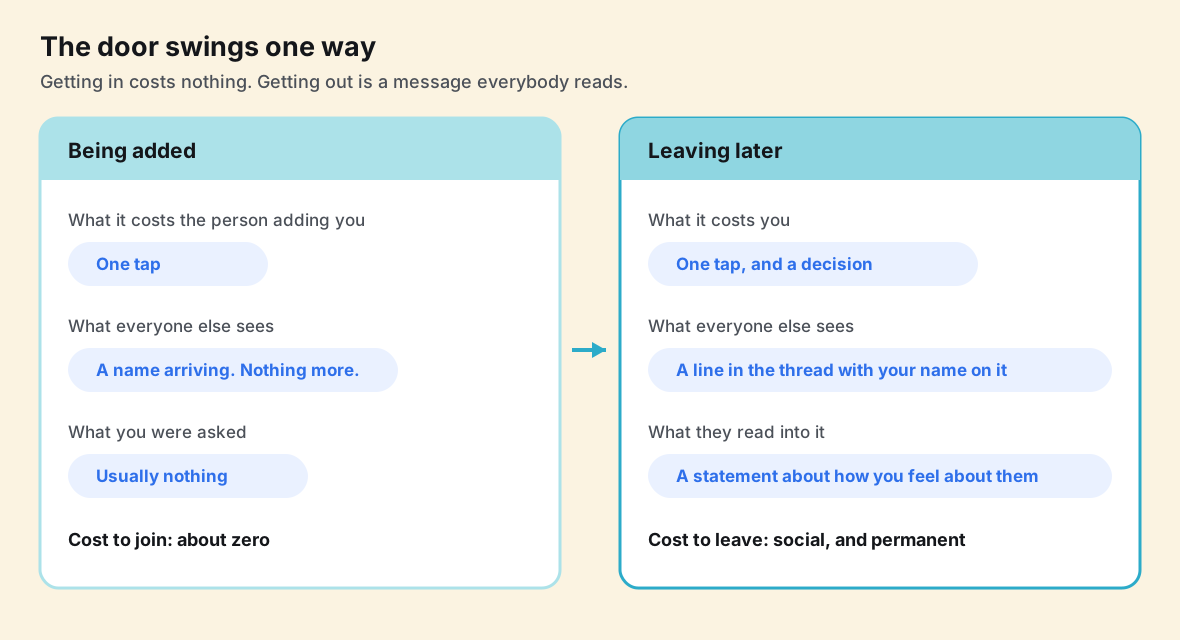
So people do the rational thing. They stay, mute, and stop reading.
Which produces the strange population every large group chat has: a dozen people present, four people talking, and eight silently hoping nothing is addressed to them directly. Membership stopped meaning participation a long time ago.
The three exits, ranked by how bad they feel
When people say they cannot leave a group chat, they mean all the available exits cost something. Here they are, in the order people actually consider them.
| The exit | What it costs you | What the group notices |
|---|---|---|
| Mute it | Nothing, immediately | Nothing, until you miss something that mattered |
| Mute and stop opening it | You lose the thread entirely | That you have gone quiet, slowly |
| Leave outright | One awkward second, permanently recorded | A system message with your name on it |
| Ask to be removed | A conversation you have to start | The same message, plus the request |
| Stay and read everything | Real, ongoing attention | Nothing, which is exactly the trap |
Look at that first column and the behaviour explains itself. Muting is free and leaving is not, so nearly everyone mutes.
The result is groups full of people who are technically present and functionally absent. That is bad for the quiet member and much worse for the organiser, who now has a member list that means nothing.
Joining hands over more than you think
There is a second cost, and it is not emotional. Joining a group makes a set of facts about you visible to everyone else in it, most of whom you did not choose.
Your phone number is the obvious one. On most number-based messengers, being in a group with someone means they can see and save your number, and there is no setting that makes you a guest instead of a contact.
That matters more for some people than others. Ask anyone who has left a job badly, ended a relationship, or been on the receiving end of a stranger who would not take a hint.
Then there is everything else the membership quietly broadcasts. Your profile photo, your display name, when you were last online in some apps, and the little grey ticks that say you read the message at 11:40pm and said nothing.
Read receipts are the underrated one. In a one-to-one chat they are a courtesy, and in a group of twenty-five they are a small public record of your attention.
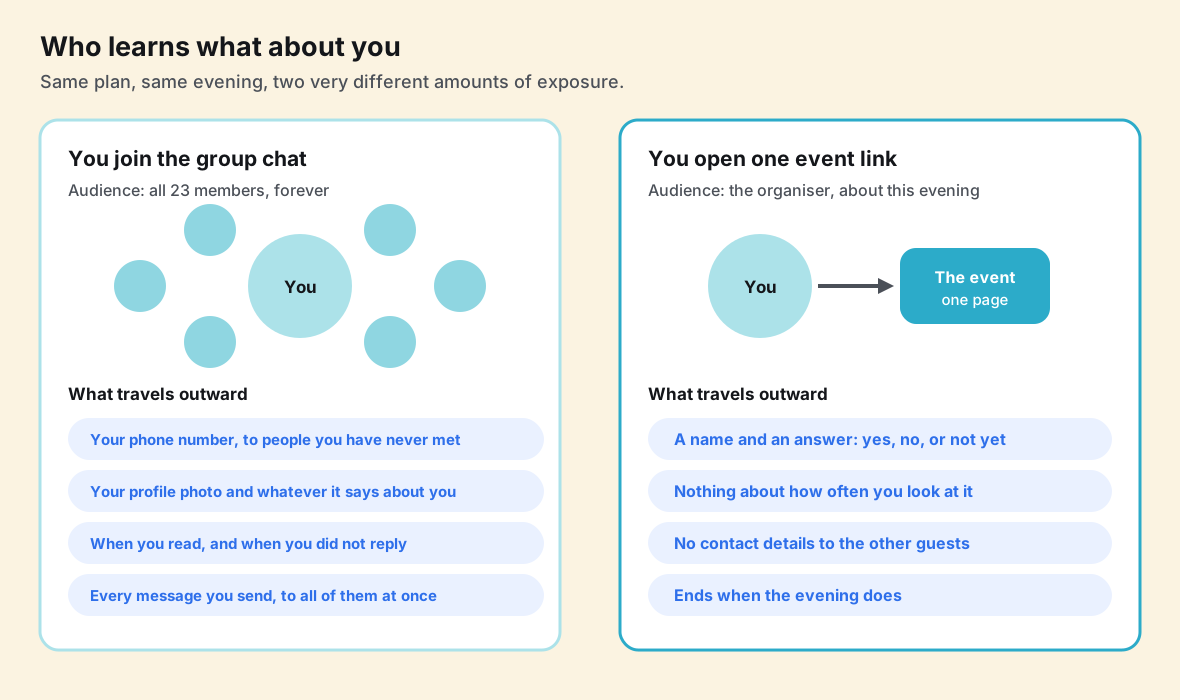
None of this makes group chats dangerous. It makes them a strong choice for people you know well, and an odd default for a plan involving people you barely know.
We have written separately about inviting people to something without handing out their phone numbers, because it comes up constantly with anything larger than close friends. The same worry sits underneath most polite declines.
The volume problem, and why one person sets it
Notification load in a group is not divided among its members. It is multiplied by them.
Twelve people who each send four messages on a lively evening produce nearly fifty interruptions. Nobody sent very much, and everybody received a lot.
Worse, the total is set by whoever is most active. One person who thinks out loud, sends things in five parts and forwards every funny video will set the volume for eleven other people who never agreed to it.
Nobody in that story is behaving badly. Being chatty in a chat is the correct use of the product.
The trouble is only that the chatty member and the quiet member are given the same room and no dial. The dial that does exist is mute, which is all or nothing.
| What lands | Roughly how often | Needs you to act |
|---|---|---|
| The actual date and place | Once, maybe twice if it moves | Yes |
| Someone asking what the date is again | Three or four times | No |
| Reactions to a message from Tuesday | Constantly | No |
| Jokes, links, photos, side threads | Most of the total | No, and often welcome |
| "Are we still on?" | The evening before | Only if you are the organiser |
| Someone typing, then stopping | Endlessly | No |
Read the middle column and the mismatch is obvious. Two useful facts arrive, wrapped in a few hundred interruptions.
The person who mutes is not rejecting the group. They are trying to keep the signal without paying for the noise, and the app gives them no way to have one without the other.
That is a design problem rather than a character flaw. We take it apart properly in the piece on how event notifications differ from group notifications, because the two are almost opposite by nature.
Being quiet in a group is not the same as being absent
Something happens to people in a room with an audience. They notice they are being observed, and their contributions get more considered and less frequent.
A one-to-one message costs nothing to send. A message to twenty-five people is a small performance, and everybody knows how it will look.
So the quiet member reads everything and writes nothing. Then they feel guilty about writing nothing, which makes writing anything harder still.
Eventually a completely ordinary question, "can you make the 14th?", takes them four days to answer. Not because they are rude, but because answering it in front of an audience feels like a bigger act than it is.
The organiser reads that silence as maybe. Nine times out of ten it means yes, and once it means no, and there is no way to tell which.
A quiet member is not a difficult guest. They are a person who has nowhere to answer privately.
This is the bit that surprises organisers most. Give the same person a private form of the same question and they answer in about eleven seconds.
The message did not become easier. The audience went away.
The organiser is not the villain here
It would be easy to write this article as a complaint about people who make group chats. That would be both unkind and wrong.
Think about what the organiser is actually holding. A date that moves, a venue that needs numbers, a couple of people who cannot answer until they check with someone else, and a growing sense that all of this is their personal responsibility.
The group chat is the only tool on offer that solves any of it. It reaches everyone at once, it is free, and it needs nobody to install anything.
So the organiser makes a group, because they have been handed an admin job and given a messaging app to do it with. Every awkward thing that follows comes from that substitution.
They also pay the highest price. They are the one repeating the address, chasing the four people who never replied, and quietly counting thumbs-up reactions into a note on their phone.
If you have ever been that person, you will recognise the specific tiredness. It is the feeling described in our piece on why WhatsApp groups get messy the moment a plan is involved.
The three things an organiser is really asking for
Strip the group chat away and the actual requirements are small.
- Everyone can see the current plan. One time, one place, and whatever it changed from. This is a reading problem, and a chat is bad at reading.
- Everyone gives an answer. Yes, no, or not yet, from each named person. This is a counting problem, and a chat cannot count.
- Changes reach people. When the time slides by an hour, everyone who said yes finds out. This is a delivery problem, and a chat is genuinely good at it.
Only the third one needs a conversation. The first two need a record, and building a room full of people is a very expensive way to get one.
That is the whole argument of the site in one paragraph, if you want the short version. The longer version lives in why a group chat is not the same thing as an event.
Why "just leave when it's over" does not work
The natural suggestion is a temporary group. Make it for the trip, delete it after the trip, everyone goes home.
In practice, almost nobody does this. Three things stop it.
The first is that no group ever formally ends. There is no last day, so there is never an obvious moment to close it, and closing it early looks like a statement.
The second is that groups get reused. The chat made for one wedding becomes the chat for that entire friendship circle, because making a new one is effort and this one already has everybody in it.
The third is the awkward one. Deleting a group where people made jokes and shared photos feels like throwing something away, even if the plan it was made for finished in March.
So the room survives its purpose by years. Most people's phones contain three or four of these: still there, still occasionally active, and firmly attached to an event that ended two summers ago.
What people actually mean when they say no to a group
It is worth translating some of these, because organisers hear them as rejection and they are almost never that.
| What they say | What it usually means | What would fix it |
|---|---|---|
| "Just send me the details" | I want the event, not the room | A link they can open without joining |
| "I'll probably be quiet in there" | I do not want to perform for 20 people | Somewhere to answer privately |
| "Is it a big group?" | Who gets my number as a result of this | A guest list that is not a contact list |
| "I'm terrible at replying to those" | I will mute it within a day | Notifications only when things change |
| "Can you just let me know nearer the time?" | I do not want six weeks of buildup | One reminder, not a running commentary |
| "Sure, add me" (then silence) | Saying no to a friend is hard | Not making joining the price of attending |
Look at that last row for a second. Plenty of people say yes to the group precisely because refusing would be a bigger deal than joining.
Then they mute it, and the organiser has gained a member and lost a guest. Everyone was polite and nothing worked.
The words that keep getting confused
A lot of this friction comes from four ideas that a chat app squashes into one action. Separating them makes the whole thing easier to talk about.
- Membership
- Being in a room. It is ongoing, visible to others, and it says something about your relationship to the group.
- Attendance
- Being at a specific thing at a specific time. It is bounded, it ends, and it says nothing beyond that evening.
- Attention
- How much of the room's activity reaches your phone. In a group chat this is set by the most active member, not by you.
- Exposure
- What other people can learn about you as a side effect. Your number, your photo, your read state, your response times.
In a group chat, one tap sets all four at once. You cannot accept the attendance without also accepting the membership, the attention and the exposure.
That is the actual complaint, stated precisely. Not "I hate group chats", but "I would like to say yes to one of those four things without buying the other three".
The distinction between belonging to something and turning up to something is worth its own read, which is what taking part without joining the community covers.
Why this matters for events specifically
Now the constructive turn. Everything above is a social observation, and it becomes a practical one the moment you are trying to get eleven people to a restaurant.
A plan should not require joining anything. That is the whole idea, and it is smaller than it sounds.
The invitation is a bounded request about one evening. The moment you deliver it by adding someone to a permanent room, you have converted a small ask into a large one, and some proportion of people will decline the large one.
They will decline politely, and they will not tell you why. You will read it as "they were busy", and you will be wrong.
Interestingly, the format for a bounded invitation has existed for a long time. The internet standard for calendar events, RFC 5545, published by the IETF in 2009, defines an event as a set of fields: a start, an end, a location, an organiser, and a list of attendees.
Each attendee carries a participation status called PARTSTAT, whose values are NEEDS-ACTION, ACCEPTED, DECLINED, TENTATIVE and DELEGATED. Not one of those values means "is a member of a room".
The default is the clever part. NEEDS-ACTION gives silence a name, so a person who has not answered is recorded as not having answered rather than being mistaken for a yes.
A companion standard, RFC 5546, which defines how invitations and replies travel, covers the sending half. It has a REQUEST and a REPLY, and no concept of adding anybody to anything.
Compare that with a group chat, where your only ways to answer are to speak in front of everybody or to react with a thumbs-up. We looked at how badly that scales in the piece on emoji reactions as attendance records.
What a plan looks like when joining is not required
Picture the same Saturday, arranged the other way round.
The organiser makes one page for the evening. It holds the date, the time, the place, and a short note about the booking.
They send that link wherever each person already is. Some get it in the existing friend group, two get it by text, one gets it forwarded by their partner, and none of them join anything.
Each guest opens it, sees the same facts, and answers. That answer goes to the organiser, not to the other ten people.
When the time moves to nine, the organiser changes it in one place. The people who said yes get told, and nobody else is disturbed.
Afterwards, the thing ends. There is no room left over, no leaving to be done, and no line in a thread with anyone's name on it.
The friendly chatter still happens, because it always does. It happens in the group chats that already exist, where it belongs, without any admin bolted onto it.
Does this mean fewer group chats?
Probably not, and it is not the aim. Groups made because people want to talk to each other are excellent and should stay.
What goes away is the other kind: groups made because the organiser needed a way to reach everyone and had nothing else to hand. Those are the ones that get muted within a week.
You can tell them apart with one question. If the plan were cancelled tomorrow, would this room still have a reason to exist?
Practical things you can do on either side of this
If you organise things, a few small habits remove most of the friction. None of them require anyone to change apps.
- Ask before adding. "Want me to add you to the chat, or shall I just send you the details?" takes four seconds and removes the entire dilemma.
- Put the facts somewhere that is not a message. A page, a pinned card, anything with one address. Then answer every question with a pointer rather than a retelling.
- Collect answers privately. A direct message or a proper RSVP gets a reply from the quiet half of your list, which a public question never will.
- Announce endings. "Right, that's this one done, I'll leave the chat up for photos and then archive it" gives everybody permission to go without it meaning anything.
- Do not read silence as no. It usually means the question arrived in front of an audience. Ask them directly and you will get an answer.
If you are the one being added, there is a version for you too. Saying "send me the details rather than adding me, I'm rubbish in group chats" is not rude, and organisers are usually relieved to be told.
It is far kinder than joining, muting, and missing the change of venue. The muted member is the one who turns up at the wrong restaurant.
Where Ontaym fits
This is the one section where we talk about our own thing, and then we will stop.
Ontaym exists because of exactly this gap. An event gets its own page with one address, and people answer it without joining a group, installing an app or handing their number to everyone else on the list.
Your existing group chats carry on untouched. They are good at conversation and we have no interest in replacing them, which is a point made at more length in keeping chat for conversation and Ontaym for coordination.
It is deliberately narrow. A club that meets every week genuinely wants a community, and two friends getting coffee need nothing at all.
The middle case is where the pain lives. Eleven people, one Saturday, and no reason on earth for any of them to acquire a permanent room.
The short version
People who dread group chats are not dreading their friends. They are dreading an unbounded commitment, an exit that costs something, an audience for every reply, and a stream of notifications set by somebody else.
Organisers are not imposing. They were handed an admin job and given a messaging app to do it with, and they are paying the highest price of anyone.
The fix is not etiquette, and it is certainly not spending less time on your phone. It is separating the plan from the room.
Let people answer a question about one evening without joining anything that outlives it. Almost everyone says yes to that, including the ones who have been quietly saying no for years.
Frequently asked questions
Why do people dread being added to a group chat?
Because being added is an open-ended commitment, not a single request. An invitation asks for one evening and then ends, while a group has no end date, no agenda and no natural moment where it stops. You are asked to accept something permanent on the basis of one Saturday.
Why is leaving a group chat so hard when it only takes two taps?
The mechanics are easy and the social cost is not. Your departure appears in the thread as a line with your name on it, and everyone who scrolls past fills in a reason for it. Since joining is silent and leaving is announced, most people mute the group instead of leaving it.
What does joining a group chat expose about me?
On number-based messengers it typically shows your phone number, display name and profile photo to every other member, including people you have never met. It also exposes your read state, so the group can see when you read a message and did not reply. None of that is required to answer a question about one evening.
Is the organiser doing something wrong by making a group?
No, and they usually pay the highest price of anyone. They have been handed an admin job and given a messaging app to do it with, so they end up repeating the address, chasing non-repliers and counting reactions by hand. The group chat is the only tool on offer that reaches everyone at once for free.
Why do quiet members take so long to answer simple questions?
Because a message to twenty-five people is a small performance rather than a reply. A perfectly ordinary question like whether you can make the 14th arrives in front of an audience, which makes answering feel larger than it is. Ask the same person privately and you usually get an answer within seconds.
Can we not just make a temporary group and delete it afterwards?
It is a good idea that almost nobody carries out. Groups have no formal last day, they get reused for the next plan because everybody is already in them, and deleting one with jokes and photos in it feels like throwing something away. Most phones hold three or four rooms that outlived their reason by years.
Does muting a group chat solve the problem?
It solves the notification half and creates a worse one. The muted member stops seeing changes, so they are the person most likely to arrive at the old time or the old venue. It also leaves the organiser with a member list that no longer tells them who is actually coming.
What is the alternative to putting a plan in a group chat?
Give the plan one address instead of one more room. The event lives on a page holding the current date, time and place, guests open the link wherever they already are, and their answer goes to the organiser rather than to the other ten people. When it ends there is no room left over and nothing to leave.
Give your next plan one address instead of one more thread.
Plan it with Ontaym